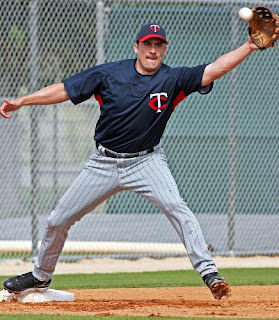
3B: Lamb
Tuesday, March 25, 2008
Catching Up
3B: Lamb
Monday, March 24, 2008
Position Analysis: Designated Hitter
2007 Stats: .273/.335/.450, 13 HR, 65 RBI
Friday, March 21, 2008
Position Analysis: Right Field
2007 Stats: .276/.356/.433, 16 HR, 81 RBI
Potential Backups: Craig Monroe, Jason Pridie, Jason Kubel, Garrett Jones
Thursday, March 20, 2008
Position Analysis: Center Field
2007 Stats: .232/.288/.304, 2 HR, 12 RBI
Potential Backups: Jason Pridie, Craig Monroe, Denard Span
With Torii Hunter out of the picture, the Twins hoped to figure out a steady answer in center field by the start of the 2008 season. Despite trading for two center field prospects during the offseason, the Twins don't appear particularly close to figuring things out.
Showing improvement after a rough start this spring, Carlos Gomez appears to be the front-runner in the battle to start in center on Opening Day. A 22-year-old who came over as the sole position player in the Johan Santana trade, Gomez had been rushed through the Mets system and appeared in 58 games for the Mets last year, appearing in mostly the corner outfield spots. Gomez struggled and posted a paltry .592 OPS while striking out in nearly 20 percent of his at-bats, but he was only 21 years old and did miss a sizable chunk of the season with a broken hand.
Widely viewed as one of the league's fastest players, Gomez is a toolsy defender and a legitimate threat on the basepaths when gets aboard. He also projects to hit for power with his big 6-for-4 frame. The problem with Gomez is that he's basically all projection at this point; he hasn't hit particularly well in the minors (which is understandable since he's been rushed and hasn't been given much time to adjust at any level) and doesn't appear truly ready to be starting in the big leagues. Yet, the Twins are likely to eager to showcase some of the talent they got back in the Santana trade, and Gomez might be the best option considering the alternatives.
Jason Pridie, who had a breakout year in Tampa Bay's system last year that included a .914 OPS over 63 games at Triple-A, is more polished than Gomez and might be a better option for the center field spot in the short-term. However, Ron Gardenhire has made clear that he views Pridie as a backup and role player, and the battle for the starting job seems to be between Gomez and Denard Span at this point.
Span has had the best spring of the three, but is a significantly inferior prospect to either Gomez or Pridie. A first-round pick in 2002, Span has moved through the Twins' system at a reasonable pace despite a failure to produce anywhere, and his lack of legitimate plate discipline or any power whatsoever make him a marginal roster candidate. He possesses some of the same tools as Gomez -- namely, defense and speed -- but Gomez is the better player and has a much brighter future. It has become fairly clear that Span doesn't have much of a future as a major-league player, whereas Gomez is a top prospect with the tools to blossom into a star. Whether the former Met will realize that potential remains to be seen, but it would certainly be more entertaining for Twins fans to watch him grow and adjust this year than to watch Span try and beat out weak grounders.
Predicted 2008 Hitting Line for Gomez: .265/.315/.390, 10 HR, 55 RBI
Wednesday, March 19, 2008
Position Analysis: Left Field
2007 Stats: .288/.316/.408, 13 HR, 93 RBI
Potential Backups: Craig Monroe, Jason Pridie, Jason Kubel
The Twins entered the offseason with numerous holes to fill, most notably third base, center field and designated hitter. Trading for Delmon Young indirectly filled one of those holes by allowing Jason Kubel to slide from left field to DH. The move should improve the team's defense in left field, and also provides them with a beefy 22-year-old with a ton of potential who could become a cornerstone in this lineup.
After being selected by Tampa Bay with the No. 1 overall pick in the 2003 draft, Young flew through the organization's minor-league system and was playing in the major leagues by September 2006. He has hit for big averages nearly everywhere he's gone, and last year finished second in the AL Rookie of the Year voting while batting .288 and appearing in all 162 of the Rays' games.
Yet, while his upside is huge, many questions surround Young. His attitude was a major problem during his time in the Rays' system; he frequently had spats with management and during the 2006 season was suspended for 50 games after throwing a bat at an umpire. Since arriving in Minnesota, Young has been saying all the right things and it appears that he has matured, but these issues will remain in the minds of fans.
Of greater concern is the fact that Young simply was not very good last year. He hit .317/.336/.476 during a September call-up in 2006, but took a step back in '07 by posting an underwhelming .724 while striking out nearly five times for every walk. I wrote recently about Young's mysterious lack of power over the past couple seasons, and his plate discipline has been almost uniformly bad throughout his professional career. These are areas where Young needs to improve if he is to become the star hitter that many believe he can be, and he needs to start showing that improvement soon. Fortunately, he's young and talented enough that it's not real difficult to see him making the adjustments to become a legitimate threat. I think he'll start making those strides this season.
Behind Young on the depth chart is Craig Monroe, who was acquired in an offseason trade with the Cubs. I've expounded upon the fact that Monroe is overpaid and really not that great of a hitter, but he should serve as a decent fourth outfielder and he's almost certain to improve on his brutal .219/.268/.370 line from last season. Young doesn't have a big platoon split, and he proved last year that he can play everyday as long as he's healthy, so I don't think there will be much need for Monroe to chip in in left field. Kubel provides an additional backup option in left, as does Jason Pridie if he's on the roster.
Predicted 2008 Hitting Line for Young: .295/.340/.480, 20 HR, 110 RBI
Tuesday, March 18, 2008
Position Analysis: Shortstop
The odds that Everett made solid contact with this ball are, sadly, not good.Potential Backups: Nick Punto, Alexi Casilla, Brendan Harris
Adam Everett has never been much of a hitter, but even by his standards, the numbers he put during an injury-shortened 2007 campaign were pretty brutal. He was hitting just .232 in mid-June when he collided with Houston left fielder Carlos Lee while chasing a pop fly and broke his right leg.
Monday, March 17, 2008
Position Analysis: Third Base

Lamb could well reverse a long-standing trend of ineptitude at third.
Potential Backups: Nick Punto, Brian Buscher, Brendan Harris, Matt Macri
Third base was an absolute disaster for the Twins last year,when the team got a collective .236/.308/.323 hitting line from the position thanks in large part to Nick Punto's historically bad season. Seeking to solve the long-standing issues at the position (the Twins haven't gotten an OPS over .712 from third base since Corey Koskie left following the '04 season), the Twins went out and signed free agent Mike Lamb to a multiyear contract.
Friday, March 14, 2008
Position Analysis: Second Base
2007 Stats: .286/.343/.434, 12 HR, 59 RBI
Harris will need to hit well enough to make up for his sub par defense.
Potential Backups: Nick Punto, Alexi Casilla, Matt Tolbert, Matt Macri
Without question, second base is the most uncertain position I have previewed so far. For starters, while we can be certain that Joe Mauer and Justin Morneau will be the starters at catcher and first base barring injury, it is far from a sure thing that Brendan Harris will be playing second base on Opening Day. Ron Gardenhire has been rotating players at second base regularly throughout spring training and hasn't given much of a hint as to who might be the leading contender. Beyond that, while we can reasonably expect that Mauer and Morneau will both put up numbers this year that fall somewhere between their excellent 2006 and disappointing 2007 campaigns, it is far more difficult to predict what type of production the Twins will get from second base, regardless of who the starter is.
I have maintained since the start of camp that Harris is the most likely candidate to get the lion's share of at-bats for the Twins at second base. While his defense leaves much to be desired, Harris was strong offensively with the Rays last year, and was an important component of the trade that sent Matt Garza, Jason Bartlett and Eduardo Morlan to Tampa Bay during the offseason. There is even more pressure for Harris to step up and be a productive starter at second after Gardenhire's revelation that he views Jason Pridie, the third player to come over in the trade along with Harris and Delmon Young, as a "role player" rather than a potential starter. If it turns out that the Twins gave up a young arm with ace potential, a starting shortstop and a top closer prospect for one starter and two backups, the Rays trade could end up looking like a flop, particularly if Young doesn't make major strides this year. All of which is to say that the general manager Bill Smith has got to be pushing for Harris to start and succeed.
So if Harris is the starter, as I suspect, what type of production can be expected? Last year Harris posted a .777 OPS which was solidly in line with the AL average for second basemen (.755) and would be a tremendous improvement over the .640 OPS the Twins got from the position last year. At 27 years old, there's plenty of reason to believe that Harris could repeat that type of production, or perhaps even improve on it. He was a .294/.365/.458 hitter in the minors, and has always displayed fairly decent plate discipline, so it's probably fair to say that the guy is a legitimate major-league hitter.
What is alarming is the fact that, since being drafted by the Cubs back in 2001, Harris has shuttled between six different organizations, and prior to last year had failed to appear in more than 20 games in a season with the same big-league club despite continually posting solid numbers in Triple-A. Clearly, these teams are seeing something they don't like. Maybe it's his defense. Whatever the case, it gives reason for concern. Still, Harris played in 137 games for Tampa Bay last year and hit consistently all year (with the exception of a rough August).
Of course, as long as Nick Punto is on the roster and Gardenhire is the skipper, No. 8 will get at-bats. I wouldn't be terribly surprised if Punto won the starting job out of spring training, but with the abhorrent .210/.291/.271 hitting line he put up last year over a ridiculous 536 plate appearances, I think the manager is going to have a hard time writing Punto's name in the lineup too often regardless of his affection for the scrappy little tail-battler. The good news is that Punto basically has to be better at the plate than he was last year, and he remains an excellent defensive player who can sub in for the range-less Harris as a late-game replacement while also filling in as a starter from time to time.
Meanwhile, Alexi Casilla seems to be the guy that everyone forgot. Casilla was one of the organization's top prospects following an excellent 2006 campaign that saw him start in Single-A Ft. Myers and finish in Minnesota, but many fans seem to have soured on him after a poor 2007 season during which he was mediocre in Triple-A and Punto-like in Minnesota. It was a very tough year to be sure, but we can't forget the talent that Casilla -- still only 23 -- possesses. He could be a factor at some point this year, although I think it's more likely that he'd do so at shortstop.
Thursday, March 13, 2008
Position Analysis: First Base
2007 Stats: .271/.343/.492, 31 HR, 111 RBI
Morneau will look to rebound after a brutal finish in '07.
Justin Morneau took a notable step back in 2007 one year after winning the American League MVP, that much is for sure. It's worth noting, however, that the two seasons may not have been as different as a lot of people think. In 2006, Morneau struggled out of the gates before going on an insane tear over the last four months of the season to finish with a tremendous .321/.375/.559 hitting line. In 2007, Morneau continued to hit well through the first four months of the season, and in fact at the end of July he was hitting .297/.363/.563 with 28 home runs and 89 RBI -- basically, he was on pace to effectively duplicate his spectacular 2006 campaign.
We know the story of those last two months. In August and September, Morneau hit a putrid .222/.305/.335 while managing just three home runs. The sour ending left Morneau with an overall hitting line that left something to be desired, but while his final 2007 OPS was about 100 points lower than the 2006 figure, the two seasons weren't really as different as one might think. Observe:
| | 2006 | 2007 |
| G | 157 | 157 |
| AB | 592 | 590 |
| HR | 34 | 31 |
| XBH | 72 | 65 |
| RBI | 130 | 111 |
| BB | 53 | 64 |
| SO | 93 | 91 |
The way that Morneau got to these final totals was vastly different, but for all intents and purposes, his production in these categories (with the exception of RBI) was essentially the same both seasons. The main reason Morneau finished with a much better hitting line in 2006 was the fact that he hit a lot more singles in 2006, leading to a .321 batting average which was probably the main reason he was able to capture the MVP.
Morneau is an excellent hitter, but there is little to suggest that we can expect him to be hitting .321 on a regular basis. That's not necessarily a problem as long he can draw walks and hit for power to keep his OPS up like he did throughout the early part of last season. It will be a problem if he can't do those things. Morneau's final 2007 hitting line of .271/.343/492 is decidedly mediocre for a starting first baseman, and he'll need to improve on that in order to truly earn the big bucks he'll be making as part of his whopping new contract. I think we can fairly assume that his future numbers will look a lot more like the ones we saw from April through July last year than the ones we saw from in August and September -- there were rumblings of a back injury that was limiting Morneau during those final two months; hopefully he is now past that.
That last point is a big one. It is critically important that Morneau stay healthy this year, because the team's depth at first base is not strong. If Brian Buscher makes the team, he would likely serve as the top backup. If Garrett Jones makes the team, he would serve in that role. If neither of those two players make the team, the top backup at first base is... Michael Cuddyer? He'd be just about the only player on the roster with significant experience at the position, but he's already the starting right fielder. There was some talk that Joe Mauer might play a few games at first base this year to rest his knees, but the fact that he has seen no action at the position during spring training suggests that such a scenario isn't overly likely.
It would be interesting to see what the Twins would do if Morneau were to go down with a serious injury this year. Let's hope we don't have to find out.
Predicted 2008 Hitting Line for Morneau: .285/.355/.540, 35 HR, 105 RBI
Wednesday, March 12, 2008
Position Analysis: Catcher
As always, we'll kick off with catcher, which once again projects to be a position of strength for the Twins:
Likely Starter: Joe Mauer
2007 Stats: .293/.382/.426, 7 HR, 60 RBI
Potential Backups: Mike Redmond, Jose Morales
Joe Mauer was unable to replicate his 2006 numbers last year, but that shouldn't really come as a big surprise. Can a 24-year-old really be expected to hit .347 two years in a row? It's surely unfair to hold it against Mauer that he "only" hit .293 with a .382 OBP last season (ranking third and second in the majors among catchers with 400-plus plate appearances, respectively), but there were a couple aspects of his game that gave cause for concern, namely power and health.
In 2006, Mauer appeared in 140 of the Twins' games and made 608 plate appearances. Last year, those numbers dropped to 109 and 471 due to various injuries, mostly to his legs. This prompted renewed calls for a position change, but for the time being Mauer is sticking at catcher. The hope is that he can stay in the lineup more this season.
Last year's health issues seemed more like a prolonged string of bad luck than anything, so I'm fairly confident he'll be in the lineup more this year. What I'm not really sure about is whether his power will materialize. Each year since he's entered the league, we've been saying the Mauer is going to grow into that 6-foot-5 frame and start showing some legitimate power. It hasn't happened. Last year he managed only seven home runs and 37 total extra-base hits, compared to 13 and 53 in '06. Obviously that is somewhat attributable to the fact that he made 22.5 percent fewer plate appearances, but as the 79-point drop in slugging percentage will attest, Mauer is clearly not showing the expected type of growth in his power game. There's reason to think that the power will come this year if he can stay healthy, but we really have no way of knowing.
Looking at Mauer's 2007 splits, there are a few things that stick out. For one thing, he was significantly better on the road than at home. When playing away from the Metrodome, Joe Mauer pieced together a .342/.436/.520 line that is roughly the same as his amazing overall hitting line in 2006. Yet, under the Teflon roof, Mauer struggled to the tune of .246/.336/.333. This massive home/away split is rather inexplicable, and I don't know that there's really any evidence to show that it's a systematic problem that can be expected to continue. (Although, it is worth noting that for whatever reason, Mauer has posted a better OPS away than at home in each of his four major-league seasons.)
The other split worth looking at is Mauer's disparity versus lefties and righties. Against right-handed pitchers last year, Mauer hit .299/.395/.481 with 32 extra-base hits; against lefties, just .283/.356/.319 with only five XBHs (all doubles). Considering Mauer carries a left-handed stick, the disparity is hardly earth-shattering, and in reality his line against southpaws wasn't really that bad (except for the abysmal lack of power). We may have expected more from Mauer against left-handers considering that he posted a .331/.401/.425 line against them in 2006, but my guess is that his success against them that year was something of a fluke, and we probably shouldn't expect him to post superhuman numbers against them.
Fortunately, this is something that the Twins can easily remedy, because Mauer's backup, Mike Redmond, is a right-handed hitter who has great success against left-handers. For his career, Redmond has posted an outstanding .332/.389/.436 line against southpaws; last year it was an even more impressive .330/.410/.443. If Ron Gardenhire can use Redmond properly -- spelling Mauer about once a week and almost always against left-handed starters -- this team stands to get fantastic production from the catcher position once again this year.
Predicted 2008 Hitting Line for Mauer: .315/.405/.500, 15 HR, 70 RBI
Monday, March 10, 2008
You're Cut
"Now it's time for the easiest part of any coach's job: the cuts. Although I wasn't able to cut everyone I wanted to, I did cut a lot of you. Wendell is cut. Rudy is cut. Janey, you're gone. Steven, I like your hustle. That's why it was so hard to cut you. Congratulations, the rest of you made the team! Except you, you and you."The Twins made their first round of spring cuts on Sunday morning, sending 12 players to the organization's minor-league camp. The group includes the following: pitchers Zach Day, Deolis Guerra, Oswaldo Sosa, Jose Mijares, Armondo Gabino and Brian Duensing; catchers Jose Morales, Allen de San Miguel and Jeff Christy; infielders Alejandro Machado and Felix Molina; and outfielder Darnell McDonald. Among these names, the only ones that are mildly surprising are Duensing, Morales and Machado.
- Homer Simpson, pee-wee football coach.
It seemed like Duensing would be a strong contender for the fifth spot in the Twins' rotation this spring after effectively conquering Triple-A last year, posting a 3.24 ERA over 116 2/3 innings there following a mid-season promotion from New Britain. Yet, for whatever reason, Duensing never seemed to be a legitimate contender to make the Opening Day roster despite possessing a reliable left arm. His name was rarely mentioned in the local papers when that fifth rotation spot was being discussed, and that means the beat writers probably weren't hearing about him much from team officials. Duensing struggled mightily in two appearances this spring, allowing five runs, five hits and five walks in 2 1/3 innings, but it's a little surprising that the Twins didn't give him more of an opportunity to showcase his skills.
Morales had a very good season in Rochester in 2007, batting .311/.366/.399 while showing some solid skills behind the plate, but he won't be on the major-league roster as long as Mike Redmond and Joe Mauer are both healthy, so there wasn't much sense in keeping him in the big-league camp.
Machado was one of about 4,523,309 utility infielders in the Twins' camp, but he is by all accounts a good defender and his plate discipline (.372 minor-league OBP) makes him an intriguing prospect, so I wouldn't have minded seeing him stick around for a bit longer.
Nonetheless, none of the cuts from this first round came as a big surprise, and there are still a lot of important decisions to be made. For what it's worth, Ron Gardenhire has indicated that Carlos Gomez may have an upper hand in the battle for center field, despite having batted .190/.208/.333 in 21 at-bats this spring:
"Sometimes with young hitters, it's better to get them 500 to 550 at-bats than worry about on-base percentage," Gardenhire said. "Just let them play."D'oh! Homer would be proud.
Friday, March 07, 2008
Can Delmon Deliver?
Young's power has been on a downward slope for the past couple seasons. The Twins are hoping that his big blast on Wednesday afternoon is an early sign that he's ready to reverse that trend in Minnesota.
Thursday, March 06, 2008
National League Preview
NL West
Outside of the pathetic San Fransisco Giants, this actually should be the most competitive division in the National League.
1) Arizona Diamondbacks
If you haven't been paying attention, Webb has had an ERA under 3.59, over 200 innings, and a K rate above 6.7 in each of the past four years and he had the amazing shutout innings run last year. In addition to the Webb-Haren tandem, the Diamondbacks also have Randy Johnson in the rotation. Johnson is 44, coming off major back surgery, and very close to retirement, but he showed in limited time last year that he can still be effective. With Doug Davis and Micah Owings finishing off the rotation, the Diamondbacks look pretty intimidating. While their offense isn't too potent, they are supported by up-and-coming stars like Justin Upton, Conor Jackson, Mark Reynolds, Stephen Drew, and Orlando Hudson. The bullpen is suspect (having traded Jose Valverde to the Astros), but two aces in the hole should have a positive effect on that.
2) Colorado Rockies
As you might be able to tell, I really like the Rockies and yes, I think they are for real. They have an impressive lineup that includes an MVP candidate in Matt Holiday (who hit .340/.405/.607 last year with 92 extra-base hits) and four above-average hitters in Todd Helton, Garrett Adkins, Brad Hawpe, and Troy Tulowitzski that can carry the team offensively (as evidenced by the .791 team OPS last year). Of course, most people point to a home-field advantage, which is understandable given the team's .298 average and .853 OPS at Coors versus a .730 OPS on the road. However, most of the best hitters outside of Tulowitzski performed adequately or above-average on the road anyway.
However, the most significant development that bodes well for the Rockies, outside of their outstanding team defensive play, is the development of a good, young pitching staff. In addition to Jeff Francis, the Rockies have solid middle-of-the-rotation guys like Aaron Cook as well as young up-and-comers like Ubaldo Jimenez, who had some memorable outings late in the year last year, and Baseball America's No. 8 ranked prospect Franklin Morales. They also have a good young closer in Manny Corpas and other potential solid starters like Taylor Buchholz (aren't you glad the Twins didn't trade for Jason Jennings?) who may survive the Rocky Mountain air.
3) Los Angeles Dodgers
Perhaps I'm being too hard on the Dodgers. After all, they have one of the best bullpens around (Takashi Saito, with a 1.77 ERA and a 185/36 K/BB ratio in 142 2/3 big league innings, and young flamethrowers Jonathan Meloan and Jonathan Broxton) as well as an impressive rotation lead by Chad Billingsley, Derek Lowe, and Brad Penny, with Jason Schmidt returning as well. The Dodgers also added 33-year-old Hiroki Kuroda from Japan, who is nearly impossible to project, as he could easily be the next Kei Igawa or the next Hideo Nomo. That staff had a 4.20 ERA last year. However, it isn't the pitching that is the most worrisome aspect of the Dodgers that will hold them back.
Even with a more competent manager in Joe Torre, the Dodgers do not possess enough firepower to get it done in the NL West. Yes, they have Jeff Kent, who somehow just keeps on hitting, as well as new addition Andruw Jones, James Loney and Russell Martin, one of the best-hitting catchers in the bigs. However, the Dodgers also have plenty of question marks. Juan Pierre is an overpaid one-tool player who will likely remain in the outfield, keeping bats from young stud Matt Kemp and the solid Andre Ethier. Despite the fact that potential star Andy LaRoche waits in the wings, the awfully mediocre Nomar Garciappara will keep sucking at-bats away at third. And shortstop Rafael Furcal is a big question mark after a sub par year last year in which he posted a .687 OPS and stole only 25 bases.
4) San Diego Padres
I predict a close and hard fought battle in the West and ultimately, I don't think that the Padres are up to the task to keep up with the Diamondbacks and Rockies. They have a very good 1-2 at the top of their rotation in Cy Young winner Jake Peavy and Chris Young, but the starting staff looks spotty to me after that. Greg Maddux can still eat innings, but he's a league average starter at this point with outstanding control keeping him in that realm. Outside of that, the rotation will likely be made up of two injury-prone pitchers (Randy Wolf and Mark Prior) and possibly a fringe-starter in Justin Germano. It's possible that Prior or Wolf, or maybe both, will have great comeback seasons, but I don't see it as likely and that hurts the Padres' chances of getting to the postseason. In limited time last year, Wolf didn't look very good (4.73 ERA, with Petco helping) and last time Prior pitched, he was a disaster (7.21 ERA in 43 innings in 2006).
Also, the Padres offense isn't terribly impressive. Outside of Adrian Gonzalez and possibly Kevin Kouzmanoff as young studs, the Pads have a shortstop with a sub-.300 OBP (Khalil Greene, who, in fairness, did show good power last year with 44 doubles and 27 homers) and two past-their-prime former stars in the outfield in Brian Giles and Jim Edmonds. In other words, too much would have to go right for this team to go to the postseason.
5) San Fransisco Giants
Outside of the awesome 1-2 punch of Matt Cain and Tim Lincecum, there is nothing to like about this team. Barry Zito is perhaps the most overpaid player in all of sports, as he can not even make it as a flyball pitcher in the cavernous A T & T Park. Noah Lowry is solid, but walks too many hitters and doesn't strike out enough to have lots of future success. There isn't much of a bullpen in the Bay to speak of. And the offense? Who is the star now that Barry is gone? Rich Aurilla (.252/.304/.368 last year)? Ray Durham (.218/.295/.343)? Omar Vizquel (.246/.305/.316)? I really feel for you, Giants fans.
NL Central
The NL Central is pretty clearly the weakest division in the NL and it is likely that only two teams will be competing for its title.
1) Milwaukee Brewers
The difference between the Cubs and the Brewers isn't all that great, but I'm giving it the Brewers simply because they have more young talent that can carry them into the playoffs. With a core of Prince Fielder, Rickie Weeks, J.J. Hardy, and Ryan Braun, the offense of the Brewers is pretty set for a few years. Specifically, Fielder and Braun were on fire last year, combining to hit .304 with 84 home runs, 216 RBI, and 200 runs. In other words, the offense will likely be the best in the NL Central.
There are questions about the rotation to be for sure. Ben Sheets is awfully talented, but he hasn't been truly healthy since 2004 and Jeff Suppan is nobody's idea of an ace. However, Yovani Gallardo is one of the better young pitchers in the game, having gone 9-5 with a 3.67 and 101 strikeouts in 110 1/3 innings last year. Also, starters Dave Bush and Chris Capuano are potential comeback candidates, as both took steps back last year. While Eric Gagne isn't the most sure-fire closer, there are as many if not more questions about the Cubs' bullpen.
2) Chicago Cubs
Pitching-wise, the Cubs have a very questionable bullpen, two good starters (Carlos Zambrano and Ted Lilly), and lots more question marks. Beyond Zambrano and Lilly, neither of which are true aces (for different reasons, as Zambrano walks far too many hitters and has seen negative trends the last few years, while Lilly is much more of a good number two), the Cubs are looking at the likes of Jason Marquis, Ryan Dempster, and Jon Lieber. Nothing to get too excited about. As for the bullpen, it sounds like Bob Howry is the closer and I can't say that is a good thing.
3) Cincinnati Reds
The Reds have plenty of talent, especially young talent, but for whatever reason, felt the need to hire possibly the worst manager in the business at dealing with young talent: Dusty Baker. If this is a win-now strategy, I'm not sure I understand it, because, frankly, the Reds haven't been a winning team for a long time, so I don't so the need for a big push. Baker will likely make silly decisions, like keeping "gritty" players like Ryan Freel over some of the best talent around like Jay Bruce, or not giving young stud Joey Votto enough time at first because "veteran" Scott Hatteberg is blocking him. Despite these likely events, the Reds will still have a good offense, because they still have Adam Dunn, Ken Griffey Jr., and Brandon Phillips.
Naturally, that leads to the problem of pitching. The Reds do have an ace in the annually underrated Aaron Harang (who led the NL in strikeouts in 2006 and got NO Cy Young votes) and Bronson Arroyo is a good option, though there are plenty of negative trends to worry about with him. After that, the Reds have "dragon-slayer" Josh Fogg and the talented but inconsistent Homer Bailey. The Reds bullpen did improve with the signing of Fransisco Cordero, but the move isn't enough to convince me that the Reds are going to be contenders this year.
4) Houston Astros
The 'Stros could easily be worse than this. Honestly, this is a team with a few stars and almost nothing else. You can blame that partially on the owner, the previous GM, and then pile the rest on Ed Wade. There was not a worse trade this offseason, at least in terms of timing, than the Miguel Tejada trade, pulled off just a day before the Mitchell Report gave us reason to think Tejada may have troubles with the law in the the future. Other than having Tejada on the downside of his career, the Astros have Roy Oswalt, Lance Berkman, Carlos Lee, and young star Hunter Pence. Beyond that, there are plenty of retreads on the team, like Darin Erstad, Shawn Chacon, and Woody Williams, along with one of the worst signings of the offseason in Kaz Matsui. Yes, the trade for Jose Valverde helped their bullpen, but they have little else and they blew up the issues with Brad Lidge to get a closer who in the past has had similar issues. Doesn't sound like the Astros are stepping forward anytime soon either, since they have an absolutely bare minor league system. Thus, if there are any injuries to major stars, the record will go down progressively.
5) St. Louis Cardinals
A lot of people will probably object to such a low placement, but this Cardinals team really is not very good at all and there is a high likelihood that they will lose their only superstar, Albert Pujols, to injury during the year. Why would he play through such a painful season when there is no chance the team will go the playoffs? Outside of that, the offense includes a Troy Glaus with his own injury/legal issues, HGH-using Rick Ankiel, and... Cesar Izturis? Seriously? Sure, there is uber-prospect Colby Rasmus, but he isn't ready to save this sinking ship.
And the pitching is not much better. Sure, Jason Isringhausen remains a middle-tier closer, but no one else is exactly sure material. As for the rotation, there is no ace, because Chris Carpenter is out. Adam Wainwright is a talented starter who can have a good year, but past that, its DL candidates like Mark Mulder and Matt Clement and bottom-of-the-bargain-bin guys like Todd Wellemeyer and Ryan Franklin.
6) Pittsburgh Pirates
The Cards would be last in my mind if the Pirates weren't such a sorry organization that just now starting to see a few bright spots. Of course, that hasn't stopped the Pirates from filling its roster with retreads like Chris Gomez and Byung-Hyun Kim. The offense has some potential with guys like Jason Bay, Adam LaRoche, and Steven Pearce, who had a great year in the minors last year. However, that doesn't amount too much of an overall offense and the same can be said about the pitching. Guys like Ian Snell, Matt Capps, and Tom Gorzelanny are talented pitchers, but there is little else surrounding them to convince anyone that the Pirates won't have another ugly, losing season.
NL East
The national press will certain put bias on this race and ignore what will likely be a tighter and potentially more interesting race in the NL West. Nonetheless, there are some good teams in the East that will fight it out.
1) New York Mets
Once again, I should note that this will be a close race, which means that the Phillies could just as easily win it, but I give the Mets the edge due to the Johan Santana trade. Although Pedro Martinez is nothing close to a guaranteed commodity anymore, the Santana/Martinez combo is certainly one to look out for. As already noted on this blog, Santana is likely to have more success, at least in 2008, by moving to the weaker National League and playing in Shea Stadium in its last year. The rest of the rotation is pretty solid, with John Maine, Oliver Perez, and Orlando Hernandez. Billy Wagner is 36, but he's still a top-tier closer and Aaron Heilman and Duaner Sanchez round out a solid bullpen.
As for their offense, some of the core is old (Carlos Delgado is going on 36 and has a possible bad injury and Luis Castillo's skills are clearly deteriorating with age), but they have two young superstars in David Wright (who arguably should have been last year's NL MVP) and Jose Reyes, as well as stars like Carlos Beltran and good bats like Moises Alou (despite being 41 and injury-prone) and newly acquired Ryan Church, who should continue to hit plenty of doubles at the spacious Shea.
2) Philadelphia Phillies
I imagine things might come down to the wire again, but I'm not sure that the Phillies will win out again. The Phillies do have a great lineup and two ace-quality starters in Cole Hamels and Brett Myers, but everything else looks suspect. The Phillies have a great core of Ryan Howard, Jimmy Rollins and Chase Utley that is supplemented by the offensive firepower of the underrated Pat Burrell, but every other position is questionable.
Pitching-wise, the Phillies have too many mediocre pitchers on the staff, from 45-year old Jamie Moyer to spotty potential starters like Adam Eaton and Ryan Madsen. Sure, they traded for Brad Lidge, but he likely starts the season hurt and is no guarantee at this point. With that, I would expect a similar season to last year -- outstanding offense held back by a below-average pitching staff.
3) Atlanta Braves
I can't see the Braves being anymore than a .500 team. The pitching staff seems far too reliant on aging veterans. Of course, John Smoltz is still an elite pitcher according to last year's numbers, but that could change anytime. Tim Hudson has been an enigma since his arrival in Atlanta, although his numbers were good last year, and Tom Glavine is clearly at his last stop before retirement. Otherwise, Atlanta is relying on a guy who hasn't pitched in the majors in over two years and a young (for Atlanta), league-average starter in Chuck James. So, while the rotation potentially could be good, the bullpen will be the real problem. They have Rafael Soriano, but no one else unless Mike Gonzalez is a comeback miracle.
The lineup has similar issues. Chipper James is a Hall of Fame caliber player, but he's also 36 and coming off a season that may be tough to top (.337/.425/.604). Mark Teixiera will be a great slugger at first, Brian McCann will likely provide above-average offense at catcher, and Kelly Johnson is looking like a very good second baseman. However, there is no obvious replacement for Andruw Jones in center (Mark Kotsay is coming off an awful offensive season) and there is a hole at shortstop as well with Edgar Renteria traded. The Braves may well be a good team, but it just isn't as easy to project them as a winning team as it was a few years back.
4) Washington Nationals
It doesn't really matter if I pick the Nationals or Marlins in the fourth spot. Both teams will be pretty hard to watch. About the only big positive Nationals fans have to dwell on is their new stadium. Marlins fans (if they exist) have no such positive news to look at. What you can say about the Nationals is that in a year or two, they may have some potent offensive players. They have lots of potential in the outfield with Elijah Dukes, Willy Mo Pena, Lastings Milledge, and Austin Kearns. That is, if Dukes doesn't lose it on his teammates anytime soon. They also have a great player at third in Ryan Zimmerman. But most of those players aren't guarantees. And, naturally, the pitching situation is far less optimistic. There are about two names on the pitching staff worth recognizing (Chad Cordero and John Patterson) and one of them is coming off a bad, injury-riddled season. The rest of the candidates for the rotation include Shawn Hill, Jason Bergmann, Matt Chico, Tim Redding, John Lannan, recent No. 1 draft pick Ross Detwiler and former Yankees prospect Tyler Clippard. Don't get too excited. It might be a few years for this team.
5) Florida Marlins
I'm picking them down here partially as punishment for what I see as selling out the fans. Owner Jeffrey Loria is infamous and he should be. The returns on the Miguel Cabrera and Dontrelle Willis trade are pretty good, but the trade also shows that Loria and the Marlins have no real commitment to winning any time soon. Thus, the Marlins will be The Hanley Ramirez Show for now with some possible excitement from guys like Jeremy Hermedia, Josh Willingham, and potential star Cameron Maybin. Of course, who knows? Maybe Dallas McPherson wins the home run title. But I'm kind of doubting it.
Wednesday, March 05, 2008
American League Preview
AL West
1. Los Angeles Angels
The Angels won this division last year with relative ease, and should do so again this year. They added Torii Hunter via free agency and traded for Jon Garland to augment their rotation, with John Lackey, Ervin Santana, Joe Saunders, Kelvim Escobar and Jered Weaver all returning. Vladimir Guerrero and Garrett Anderson are getting older, but have remained productive. Meanwhile, talented young hitters like Reggie Willits, Howie Kendrick and Brandon Wood will be given an opportunity to establish themselves. The bullpen, led by closer Francisco Rodriguez and set-up man Scot Shields, should be effective.
2. Seattle Mariners
Many people felt that the Mariners got lucky last year, as their 88-64 record was a considerable step up from their Pythagorean record of 79-83. I'm not so sure. This team hit well, but lost a number of blowout games because of an inconsistent and flawed pitching staff. For this reason, the offseason additions of Erik Bedard and Carlos Silva should be huge. In Bedard and Felix Hernandez, the Mariners have a pair of starters who could both compete for the Cy Young. The bullpen -- highlighted by J.J. Putz, Ryan Rowland-Smith and youngster Brandon Morrow -- should be a strength.
I'm just not sure that Seattle will get enough offense to keep up with the Angels. Gone is the team's top young hitter, Adam Jones, along with Jose Guillen. First baseman Richie Sexson and second baseman Jose Lopez need to rebound from hugely disappointing 2007 campaigns. Ichiro has shown no signs of slowing down, but at age 34, he could any time now.
3. Oakland Athletics
The A's are clearly in a re-tooling phase, having traded ace Dan Haren and slugger Nick Swisher during the offseason. Starter Joe Blanton and closer Huston Street could be the next to leave. I can't imagine that the A's will stick with the Mariners and Angels for too long, but they do have young talent and could surprise. Carlos Gonzalez, the prize return in the Haren trade, should make in impact in the outfield. The pitching staff should be solid even without Haren, and a few pitchers acruiqed in that trade may also contribute.
4. Texas Rangers
The Rangers lost 87 games and finished last in the West in 2007, and there's little reason to believe they'll improve much this year. Josh Hamilton joins the outfield, but outside of him the team made no significant additions offensively. Meanwhile, the pitching staff remains very much a work in progress, with inexperienced hurlers such as Kason Gabbard, Robinson Tejeda and Brandon McCarthy still learning their way through the big leagues.
AL Central
1. Cleveland Indians
I've heard a number of people claim that the Indians' success in 2007 was something of a fluke. I'm not buying it. This team should continue to be strong here in '08. Fausto Carmona is for real, with his nasty hard sinking stuff, and C.C. Sabathia will be motivated to succeed in his final year before free agency. Meanwhile, Jake Westbrook and Paul Byrd are coming off solid campaigns in '07, and prospect Adam Miller could broach the rotation at some point during the season. The bullpen should again be a strength, with Rafael Betancourt and Rafael Perez returning and Masahide Kobayashi coming over from Japan.
Offensively, the Indians could improve. Grady Sizemore and Travis Hafner, arguably the team's top two hitter, both played below their potential last season and could both be MVP candidates this year.
2. Detroit Tigers
After some key offseason acquisitions, the Tigers might be the best offensive team in the league. The addition of Miguel Cabrera at third base will immensely improve that position, and Edgar Renteria should provide a solid presence at shortstop with Carlos Guillen shifting over to first. Add in Placido Polanco at second, and this is a stellar infield. The outfield allignment is nothing to scoff at either, with Curtis Granderson (.913 OPS last year) manning center field alongside Magglio Ordonez (MVP runner-up) in right. Gary Sheffield will contribute as well.
There are definitely some concerns on this pitching staff beyond Justin Verlander though. It seems the enigmatic Jeremy Bonderman may never pitch up to his ability. Kenny Rogers is 43. Dontrelle Willis struggled last year and is moving into a tougher league. The bullpen features even more questions, with Joel Zumaya likely out for at least half the season. Closer Todd Jones is far from dominant despite his high save totals.
The biggest problem for this team might be the fact that they traded a lot of good prospects during the offseason, and lack much depth. A few injuries to this veteran team could cripple their chances of taking the division. If the pitching staff holds up, though, they will be a force to be reckoned with.
3. Minnesota Twins
It was a busy offseason for the Twins. The losses of Johan Santana and Silva leave them with a rather young and inexperienced rotation, one which could struggle if Francisco Liriano isn't able to come back strong while Scott Baker and Boof Bonser step up. The offense is likely to improve but won't likely be better than average. Combine that with what will probably be an average pitching staff, and you've got a fairly mediocre team overall. The Twins can compete if a number of things go right, but realistically this is probably about a .500 team.
4. Chicago White Sox
After adding Swisher, Orlando Cabrera and Cuban Alexei Ramirez, the Sox are a good bet to improve an offense that ranked last in the American League last season. Still, they've got a long ways to go before their offense can actually be considered "good," and none of the players acquired are likely to turn things around dramatically. The pitching staff lacks a true ace, and the bullpen -- which ranked 12th in the AL with a 5.47 ERA last year -- is not likely to improve significantly. The Sox will probably be better than last year, but they're not good enough to compete in this division.
5. Kansas City Royals
This team might be a candidate to surprise, but I don't think they have quite enough talent to escape the cellar in what should be a tough division. Much will depend on young players like Brian Bannister, Alex Gordon and Billy Butler, all of whom are candidates for breakout years.
AL East
1. Boston Red Sox
The Red Sox were an unstoppable force last year, and there's little reason to think that this season will be any different. Most of the championship roster returns, and there's reason to believe the pitching staff -- which ranked first in the AL in ERA last season -- will be even better. Josh Beckett was stellar last year and really turned it on in the postseason while Daisuke Matsuzaka has had a full season to adjust to American baseball. Young hurlers Clay Buchholz and Jon Lester gained valuable experience last year and could both be key members of the rotation. The bullpen is young and talented. The offense returns every starter after scoring 867 runs last year.
2. New York Yankees
I believe Hank Steinbrenner will look back and regret not making a more aggressive push for Santana. The Yankees needed him if they were going to compete with the juggernaut Red Sox this year. As it stands, they will be relying heavily on their trio of talented young starters -- Phil Hughes, Joba Chamberlain and Ian Kennedy -- and hoping that crafty vets Mike Mussina and Andy Pettitte can make it through the season in good health. Really, Chien-Ming Wang is the only known commodity in this rotation. The bullpen does not project strongly.
The Yankees led the AL in scoring last year, and no one doubts that this offense will put runs on the board. The question is whether the pitching staff can hold up under the pressure. There are some good hitters in this division.
3. Tampa Bay Rays
Perhaps I'm going out on a limb with this pick, but boy is this a talented young roster. The Rays feature a great trio of young pitchers at the head of their rotation in Scott Kazmir, James Shields and Matt Garza. Meanwhile, the offense features several studs, from Carl Crawford to B.J. Upton to Carlos Pena (who quietly had an absolutely stellar season last year) to Rookie of the Year candidate Evan Longoria. The bullpen could present some problems, but I think this is a team that could surprise some people.
4. Toronto Blue Jays
Every year, it seems that the Jays have a highly talented roster and could contend with the Twin Titans for a playoff spot, but each year they come up short. The pitching staff should be strong as long as Roy Halladay and A.J. Burnett stay healthy, but it's difficult to see this offense -- which ranked tenth in the AL in runs scored last year -- improving much with its only significant offseason acquisitions coming in the form of oft-injured third baseman Scott Rolen and scrappy (yet crappy) shortstop David Eckstein.
5. Baltimore Orioles
With top pitcher Bedard and slugging shortstop Miguel Tejada out of the picture, the Orioles will probably spend the 2008 season dwelling at the bottom of the AL East while developing some raw but talented young pitchers like Adam Loewen, Radhames Liz and Daniel Cabrera.
Tuesday, March 04, 2008
Twins 8, Reds 6
Carlos Gomez, who is in a three-way battle for the starting center field job, got the start and batted lead-off. He went 1-for-2 with an RBI double, a walk, and a stolen base. Alexi Casilla, who started at shortstop, also stole a pair of bases. Ron Gardenhire has not been timid about sending those two speedsters when they've reached first base so far this spring; I have to wonder whether this represents a fundamental change in the manager's usually conservative philosophy, or whether he's just letting them fly because it's early spring. Time will tell.
Joe Mauer went 1-for-3 with an RBI double and is hitting .500 this spring. Glen Perkins got the start and pitched two innings, allowing a run on two hits and two walks with no strikeouts. He seems to be struggling a bit. Philip Humber, who was roughed up in an outing against Concordia College about a week ago, tossed a perfect seventh.
Tomorrow afternoon the Twins look to raise their spring winning percentage to .500 as they face off against Tampa Bay, and then on Wednesday they will face the the Yankees in a game that will be televised nationally on ESPN.
Monday, March 03, 2008
In the Win Column
2. Nick Punto, 2B
3. Michael Cuddyer, RF
4. Justin Morneau, 1B
5. Jason Kubel, LF
6. Mike Redmond, C
7. Brian Buscher, 3B
8. Jon Knott, DH
9. Adam Everett, SS
Gomez led off the first inning with a single against Red Sox starter Jon Lester and stole second on the next pitch.
In his next two plate appearances, Gomez came up with runners on base and took some tenacious swings that left Gardenhire chuckling. "I really think he swung so hard that the bat broke before the ball got there," Gardenhire said. "... He's a little bit of a free spirit."
Gardenhire met with Gomez on Saturday and encouraged him to keep being aggressive. "He took it to heart," Gardenhire said. "He looks at me and says, 'Boy, I like this guy.'"He was hacking; nothing wrong with that. I like the way he plays. He's pretty fast, and he can be pretty exciting."
Young swung at more pitches last year (1,484) than any player in baseball. But he took the first six pitches he saw for balls Saturday, drawing a first-inning walk that loaded the bases, and then ripped a run-scoring single in the second inning.
Instead of pleading for more patience, as Young's former team did in Tampa Bay, the Twins have asked him to stay aggressive.
"All the on-base percentage [stats] and all those things -- he's dangerous when he lets that thing fly and gets fastballs," Gardenhire said. "We're going to want him to swing this year more than taking a lot of pitches and watching them go by.
"And I think he'll be more than willing to let them fly."
Friday, February 29, 2008
Let the Games Begin
Of course, this was only the first game of the spring, so it's far too early to draw any conclusions or become overly concerned. Here's hoping the Twins look better tonight, with Boof Bonser facing off against Boston Daisuke Matsuzaka.
Sorry for the skimpy post today, but it was a long week and I'm beat. If anyone has anything interesting to discuss or debate in the comments section, I'll be around. Have a good weekend all.
* EDIT: Also, make sure to visit Twins Territory. They've launched their revamped and re-designed blog/fan community and it looks great!
Thursday, February 28, 2008
Thin at the Top
Wednesday, February 27, 2008
Second-Half Performances: Trend or Mirage?
Whatever the case, oftentimes we can look at a player's second half and use it as a predictor as to how he will perform in the next season. It makes intuitive sense that a player is more likely to carry his performance from the latter half a season forward, rather than the early part of the season. With this in mind, let's take a look at some Twins players who saw their performance rise or fall in the second half of 2007, and judge whether or not we can expect those second-half trends to carry over into the 2008 season.
1. PAT NESHEK, RP
First half: 42.1 IP, 1.70 ERA, 52 K/13 BB, opp .129/.205/.243
Second half: 28 IP, 4.82 ERA, 22 K/14 BB, opp .260/.347/.440
MIRAGE
Neshek's drop-off in the second half last season was dramatic, and I'd be lying if I said I wasn't somewhat concerned. However, for the time being, I am inclined to label it as a mirage. Before being shut down mid-way through September, Neshek had appeared in a total of 74 games last year. That is a ton for a guy whose previous high for an entire season was 65 (set the previous year). While his innings load (70 1/3) was not that bad, it wears a pitcher down to warm up and enter games that frequently, and indeed Neshek was shelved with two weeks left because his arm had worn down. More than likely, that's why we saw his numbers drop off after the All-Star break. He enters this season with a fresh arm after a winter of rest, and hopefully Ron Gardenhire will be a little less liberal about forcing Neshek to warm up and enter games several nights in a row just to get an out or two.
2. JASON KUBEL, OF
First half: 240 AB, .250/.302/.404, 7 HR, 37 RBI
Second half: 178 AB, .303/.379/.511, 6 HR, 28 RBI
TREND
Kubel seemed out of his element for much of 2006 after missing the entire 2005 campaign in the aftermath of major knee surgery. His struggles carried over into the early part of the 2007 season, where he appeared tentative at the plate and seemed to struggle with his pitch recognition. However, even during the hard times, Kubel always made hard contact, and as he began to regain the plate discipline that he showed throughout the minors, his numbers began to improve rapidly. Prior to the All-Star break last year, Kubel's K/BB ratio was 2.6; afterward, that number dropped to 1.4. The latter number is much more in line with his minor-league K/BB ratio of 1.1, and as such it should be no surprise that his second-half hitting line was extremely similar to this career hitting line in the minors of .320/.385/.499. Expect similar things in 2008.
3. MATT GUERRIER, RP
First half: 53 IP, 1.70 ERA, 37 K/13 BB, opp .183/.246/.253
Second half: 35 IP, 3.34 ERA, 31 K/8 BB, opp .272/.318/.463
TREND
Guerrier has always been a pretty solid pitcher, but I don't think there's really any question that he was playing way over his head in the first half last year. His luck evened out in the second half, when his ERA and opponents' OPS shot way up despite the fact that he improved his strikeout rate considerably and maintained a relatively modest walk rate. Considering his past performance and his age, I think it's much more realistic to expect an ERA around 3.34 than around 1.70 from Guerrier. Fortunately, that's still very solid.
4. JUSTIN MORNEAU, 1B
First half: 322 AB, .295/.364/.581, 24 HR, 74 RBI
Second half: 268 AB, .243/.318/.384, 7 HR, 37 RBI
MIRAGE
Through the first four months or so of the 2007 season, Morneau continued to post numbers very similar to the ones he racked up during his MVP campaign in 2006. Then, in August and September, Morneau completely fell apart. After hammering 28 home runs through the end of July, Morneau managed a measly three home runs during the season's final 56 games. The drop-off in power isn't completely shocking, since we saw the same trend even during his magnificent '06 campaign (albeit to a much lesser degree), but in 2007 Morneau lacked a .342 second-half batting average to offset the power outage. His offensive numbers down the stretch last year were dreadful, and it seems completely inexplicable. As far as I'm aware, he had no major injuries, and the drop-off in production did not come along with a noticeable increase in strikeouts or decrease in walks. With all these facts in mind, I'm inclined to pass off Morneau's dud second half as a really bad two-month stretch, rather than a fundamental decline in ability. Considering the massive contract he recently signed, we'd better hope that is the case.