
Reactions to Justin Morneau's winning of the 2006 AL MVP have ranged from subdued excitement from Twins fans to unabashed disgust portrayed by the national media. For my part, I certainly can admit that Morneau probably was not the most deserving candidate, but I do believe he was closer than a lot of people (even Twins fans) are giving credit for.
When it comes to MVP consideration, I think the best metaphor is this:
Pretend that immediately following the 2006 season, every American League team released all of their players and put them into one big pool, and each team was forced to draft all their players from scratch. Imagine that you are the general manager of the team with the No. 1 pick, and you must choose a player to build your team around. Keep in mind that your team's objective is only to find success in the first season following the draft, so the age of the player is inconsequential.
Who would you select with that pick? Would you take Justin Morneau or Jermaine Dye? Perhaps; those are probably the most desirable players at their respective positions, but the fact is that both first base and right field are deep in offensive talent, so you could probably find a pretty good hitter at either position in the later rounds. Would you use the pick on a DH like Frank Thomas, Travis Hafner or David Ortiz? Well, it would be difficult to justify using that top pick to take a player who can't even play a defensive position. Would you select Derek Jeter? He might be a good choice; you can count on him to hit for great average and he gives you good speed on the basepaths. He also plays a highly important defensive position (albeit not particularly well). However, Jeter will provide very little power, and it's certainly worth questioning whether you'd really want to build your team around a table-setter type. A similar argument surrounds Joe Mauer. He hit for the best average in the league and he has excellent plate discipline, yet he lacks power. In his support, he plays the most important defensive position on the field and he plays it extremely well. Mauer would not be a bad pick by any means. Neither would Grady Sizemore, who is the complete package. He plays a position that is not deep in offensive talent, and he plays it well. He hits for good average and great power, and he can draw walks (he is, however, quite strikeout-prone). The fact that he played in all 162 of his team's games in the 2006 season is a testament to his durability.
If it were me picking, I personally would use that top draft pick on Johan Santana. He may play only once every five games, but his impact in those games is great enough that I feel he is more valuable than any of the offensive players listed above. Still, I don't think this is a year where one player set himself apart to the degree that any one of the players listed above would be a ridiculously bad selection. And I certainly see the sound logic behind choosing Morneau.
Sure, Morneau plays first base, and there are a number of good offensive first basemen around the league, which inherently reduces Morneau's overall value. Still, when you look at the season he had, there are a lot of things which scream of high value. His overall line was terrific: .321/.375/.559 with 34 home runs and 130 RBI. I'm not sure that I buy into the hype about his "greatest four-month stretch in modern history." He had a great span, to be sure, but you have to look at the year as a whole and you can't ignore the fact that he was pretty awful for the first month-and-a-half or so.
Morneau came through when it counted though. He hit .323/.401/.575 with runners in scoring position, .389/.364/.667 with the bases loaded, and .299/.343/.540 in "Close and Late" situations. He was well-rounded, hitting well both before and after the All-Star break, both at home and on the road, and against both left-handed and right-handed pitching. And his defense at first base was at least sufficient.
The points mentioned above all paint a picture of Morneau as a sweet-hitting slugger and who got the job done when he needed to. He provided some of the most memorable moments in the 2006 Twins' season, including his walk-off, two-run single against Mariano Rivera and the Yankees and his dramatic eighth-inning home run off of flamethrowing Joel Zumaya of Detroit. If those aren't the types of qualities that make a player among the most valuable in the league, then I don't know what are.
While I'd certainly be inclined to agree that Morneau was not even the most valuable player on his own team, I think it's outrageous to claim that it was "one of the worst MVP selections in history." This wasn't a year where one player was outright spectacular and separated himself from the pack to the degree that choosing anyone else is indefensible. While Morneau might not have been the best choice, I can certainly live with his selection and I'm happy to see him win the award.
Monday, November 27, 2006


Saturday, November 25, 2006
Market of Insanity
One of the last posts I put up was commenting on the possible trades or free agent signings the Twins could try and make this winter. At the time, I felt like there just weren't many options. Now, it seems quite different. It feels impossible for the Twins to do anything now.
Just yesterday, the Astros signed Carlos Lee to a 6 year, $100 million contract. Here are the many ways that is pure insanity: Lee has never had a year with an OPS over .900, is a 30-year old coming off a career year of 37 HRs and 116 RBI, is not a particularly patient hitter (he had one good year with walks, drawing 75, but he also hit .264 that year), and is an awful outfielder. In the AL, there is of course the option to DH, but in the NL, they'll have to play him daily and watched him botch play after play on the giant Minute Maid Park wall.
So what does this mean for the Twins? Well, for one, the Lee signing isn't the most insane deal of the offseason. The Alfonso Soriano contract of 8 years, $136 million given by the Cubs is just as bad. Like Lee, Soriano probably already had his best year and isn't likely to age well. He's a speedy player with power, but he has little patience--already a problem with most of the Cubs hitters--and speed isn't an asset most hang onto later in their careers.
It gets worse. The Gary Matthews, Jr. deal? A 5 year, $50 million deal for a career utility player and 32-year old outfielder who had one good year? A 5 year, $44 million deal for Juan Pierre, a center fielder with an arm worse than Jason Tyner's and whose only real aspect, like Tyner's, is speed? (Not that I'm really comparing the two, but that kind of money for a one-dimensional player is beyond me)
All these deals add up to a major problem for the Twins. It doesn't just mean that they will have trouble signing any free agents they may want. It will affect trades they may potentially want to make and the extensions that they need to give to Joe Mauer, MVP Justin Morneau, and maybe Michael Cuddyer.
In all honesty, I never really expected the Twins to make a free agent splash anyway. Well, more specifically, I hoped that Terry Ryan would be smart enough to avoid doing so. The free agent market is very weak this offseason, as far as I can tell. Soriano, a great player but not an elite player, got the kind of deal that has been given only to Hall of Fame caliber players (well, minus Mike Hampton in 2000): Alex Rodriguez, Derek Jeter, Manny Ramirez, and Todd Helton (that may be up for debate to some, but a career .333/.430/.593 with 413 doubles is pretty impressive, even with the Coors factor) and the most recent 8-year deal was given to Scott Rolen, another Hall of Fame caliber player.
With that in mind, the price for even mediocre players has sky-rocketed. Jamie Walker, a 35-year-old lefty specialist who doesn't exactly eat innings, is getting paid nearly $4 million a year. Same with Mike Stanton, a 39-year old journeyman. That means it might take an awful lot to get even a guy like Jason Jennings on the trade market, one of the Twins' apparent targets.
If this trend continues, which it likely will, they should look inward. One of the few sensible deals of the offseason was the four year, $13.25 million extension the Rockies gave to Jeff Francis. Last season, Francis, the ninth-overall pick in the 2002 draft, went 13-11 with a 4.16 ERA and 1.29 WHIP and threw 199 innings. At Coors Field, that's certainly getting the job done, but even in the new market and the offensive era that baseball currently occupies, that is a smart deal. With a fifth-year option, the average yearly salary is just over $3.25 million a year for a guy with who can put up a solid ERA, eat innings, and doesn't walk too many. Those are valuable assets for that kind of money, even if 2006 was a bit of a fluke for Francis. (Jennings may have had more of a fluke year; Francis' HR rate went down, his GB/FB increased from 1.00 to 1.24.)
The Twins may want to do the same. Spending the money they have available this offseason to lock up Mauer, Mornuea, and Cuddyer, and possibly extend others like Johan Santana would be the smartest. They should probably still keep options open on a starting pitcher and a DH, but the focus should be on the kind of deals that will more likely pay off. Deals like that given to Soriano and Lee will probably hurt a club down the line or even next year, but extending young, talented players, while still a risk, is a much better investment for a small market team.
Considering all the ridiculous and idiotic dealing going on this offseason, I would be more than happy if the only thing the Twins did this offseason is make moves to keep the M & M Boys around for a long time. I doubt too many Twins fans could complain about that.
Just yesterday, the Astros signed Carlos Lee to a 6 year, $100 million contract. Here are the many ways that is pure insanity: Lee has never had a year with an OPS over .900, is a 30-year old coming off a career year of 37 HRs and 116 RBI, is not a particularly patient hitter (he had one good year with walks, drawing 75, but he also hit .264 that year), and is an awful outfielder. In the AL, there is of course the option to DH, but in the NL, they'll have to play him daily and watched him botch play after play on the giant Minute Maid Park wall.
So what does this mean for the Twins? Well, for one, the Lee signing isn't the most insane deal of the offseason. The Alfonso Soriano contract of 8 years, $136 million given by the Cubs is just as bad. Like Lee, Soriano probably already had his best year and isn't likely to age well. He's a speedy player with power, but he has little patience--already a problem with most of the Cubs hitters--and speed isn't an asset most hang onto later in their careers.
It gets worse. The Gary Matthews, Jr. deal? A 5 year, $50 million deal for a career utility player and 32-year old outfielder who had one good year? A 5 year, $44 million deal for Juan Pierre, a center fielder with an arm worse than Jason Tyner's and whose only real aspect, like Tyner's, is speed? (Not that I'm really comparing the two, but that kind of money for a one-dimensional player is beyond me)
All these deals add up to a major problem for the Twins. It doesn't just mean that they will have trouble signing any free agents they may want. It will affect trades they may potentially want to make and the extensions that they need to give to Joe Mauer, MVP Justin Morneau, and maybe Michael Cuddyer.
In all honesty, I never really expected the Twins to make a free agent splash anyway. Well, more specifically, I hoped that Terry Ryan would be smart enough to avoid doing so. The free agent market is very weak this offseason, as far as I can tell. Soriano, a great player but not an elite player, got the kind of deal that has been given only to Hall of Fame caliber players (well, minus Mike Hampton in 2000): Alex Rodriguez, Derek Jeter, Manny Ramirez, and Todd Helton (that may be up for debate to some, but a career .333/.430/.593 with 413 doubles is pretty impressive, even with the Coors factor) and the most recent 8-year deal was given to Scott Rolen, another Hall of Fame caliber player.
With that in mind, the price for even mediocre players has sky-rocketed. Jamie Walker, a 35-year-old lefty specialist who doesn't exactly eat innings, is getting paid nearly $4 million a year. Same with Mike Stanton, a 39-year old journeyman. That means it might take an awful lot to get even a guy like Jason Jennings on the trade market, one of the Twins' apparent targets.
If this trend continues, which it likely will, they should look inward. One of the few sensible deals of the offseason was the four year, $13.25 million extension the Rockies gave to Jeff Francis. Last season, Francis, the ninth-overall pick in the 2002 draft, went 13-11 with a 4.16 ERA and 1.29 WHIP and threw 199 innings. At Coors Field, that's certainly getting the job done, but even in the new market and the offensive era that baseball currently occupies, that is a smart deal. With a fifth-year option, the average yearly salary is just over $3.25 million a year for a guy with who can put up a solid ERA, eat innings, and doesn't walk too many. Those are valuable assets for that kind of money, even if 2006 was a bit of a fluke for Francis. (Jennings may have had more of a fluke year; Francis' HR rate went down, his GB/FB increased from 1.00 to 1.24.)
The Twins may want to do the same. Spending the money they have available this offseason to lock up Mauer, Mornuea, and Cuddyer, and possibly extend others like Johan Santana would be the smartest. They should probably still keep options open on a starting pitcher and a DH, but the focus should be on the kind of deals that will more likely pay off. Deals like that given to Soriano and Lee will probably hurt a club down the line or even next year, but extending young, talented players, while still a risk, is a much better investment for a small market team.
Considering all the ridiculous and idiotic dealing going on this offseason, I would be more than happy if the only thing the Twins did this offseason is make moves to keep the M & M Boys around for a long time. I doubt too many Twins fans could complain about that.
Wednesday, November 22, 2006
Mixed Feelings
Yesterday at around noon, a major surprise was announced in baseball. Well, that is, if you set aside the absurd contracts being given to the likes of Juan Pierre, Alfonso Soriano, and others, Justin Morneau winning the AL MVP award is pretty surprising. At the same time, it's almost an ambiguous feeling I get in considering it.
When me and my fellow blogger, Mr. Nelson, chose our picks for awards weeks ago, we both picked Twins for MVP but neither of us picked Morneau. I chose Joe Mauer. Oddly, I agree with ESPN's Keith Law (yes, its an Insider story. Yes, ESPN's Insider thing is incredibly dumb), whom I find to have an asserted and obvious dislike for the Twins at times. For one, Mauer is a catcher and likely the best catcher in the bigs, as his offense and defense are both spectacular. I don't think I need to recite any of the stats, since everyone has seen them over and over again by now, but Mauer had one of the best seasons for a catcher EVER.
There is no joke in that. Mauer's season falls in there with Piazza, Bench, Berra, Fisk, and the other few great offensive catchers. Mauer is the only catcher to ever win a major league batting title and his .347 average is one of the highest ever for a catcher, falling below only Piazza (.362, 1997). When a player has a historically great season and there isn't a clear MVP candidate, I would think the choice would be clear.
However, the same thing can be said about Johan Santana. Considering the offensive era and year he pitched in, his year was incredible. He was also the first pitcher to win the Major League Pitching Triple Crown since Dwight Gooden in 1985. In our recent post on Santana, we mentioned the other historical great things he has done. I am a believer that a pitcher who has a historically great season with no clear offensive MVP deserves the award. Pedro should have won it in 2000, Roger Clemens did win it in 1986, and Gooden probably should have won it in 1985.
Despite all the potential reasons not to support Morneau for MVP, he did win it and it's awfully hard to be upset about it. He did have a great second half, hitting .362, and his 130 RBI are the second most in Twins history, next to Harmon Killebrew's 140 in 1969's MVP campaign. The core issue is the obsession voters have with slugging first basemen. We saw it with Ryan Howard winning the NL award this year, and there are plenty of past examples: Jason Giambi (for all purposes, a DH) in 2000, Mo Vaughn in 1995 (what an awful choice that was), Ken Caminiti in 1996, and Jeff Bagwell and Frank Thomas in 1994. The Thomas and Bagwell choices were obvious, but many of the others were chosen with better candidates available.
As already mentioned, Pedro should have been the obvious winner over Giambi in 2000. Pujols, another slugging first basemen--albeit one who plays good defense--should have won in the NL this year, but the voters obsession with homers and RBI became quite clear. Voters seem to avoid looking at other stats, like runs created, VORP, numbers with RISP (Pujols hit nearly .400, Howard hit around .260), and game-winning homers (Pujols had a ridiculous 18). In 1995, Vaughn won because Edgar Martinez, who had an incredible year hitting .356 with 52 doubles and a 1.107 OPS, was a designated while Vaughn was a shoddy first baseman who should have been DHing but had more home runs than Martinez.
Is all this to say that I am adamently angry about the results of this year's MVP vote? Yes and no. I'm happy that Morneau won the award. How couldn't I be? He plays for my favorite team and he had a phenomenal year. At the same time, the continued preference of the voters is consistently annoying. When a player has an amazing career, half the time, it is ignored by MVP voters. It's a tough position, but I think it has to be consistently said that the voting process is watered down to the point that it's hard to put much stock in the awards. Nonetheless, I'm happy to see a Twin win it.
The thing is, while all these points are legitimate and the voters make ridiculous decisions practically yearly, there isn't much to do about it and lets face it: too many people spend too much time discussing. The thing is, Morneau really had a great year. His second half is worthy of infinite praise. He had the most two-out RBIs in the AL and hit a ridiculous .593/.511/1.074 with a man on third and less than two outs, collecting 40 RBI and 11 sac flies along the way.
He also, notably, was hitting .235/.295/.444 with 6 HR and 23 RBI on June 8th, just before his breakout 2 HR, 5 RBI game against the Orioles the next day. In the combined months of June and July, he hit .387 with 18 HRs and 52 RBI. That is an incredible two months and, of course, in those months, the Twins went 38-15, including 36-10 after June 8.
It also is a good story. Morneau's 2005 season wasn't downright awful, but it wasn't very good either and some people felt that Morneau might not live up to his expectations. To go from a season that casts so much doubt on a player to a season in which he wins the MVP and helps lead his team to the playoffs is something worth rewarding as well. While Santana and Mauer were certainly worthy, and maybe more so than Justin, it's pointless to scrabble over it when a Twin won it. His teammates were proud to see him win it and thought he deserved it. Although I agree with Law that Mauer and Santana were better candidates, I don't think it was a "laughable pick."
A Twin for MVP, a Twin for Cy Young, a Twin for Executive of the Year, and plenty more votes in other races? Not too shabby for the 2006 Twinkies. Congrats, Justin, and lets hope the voters eventually figure things out.
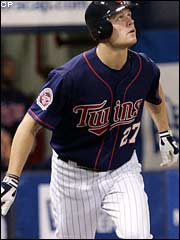 Justin Morneau - 2006 AL MVP
When me and my fellow blogger, Mr. Nelson, chose our picks for awards weeks ago, we both picked Twins for MVP but neither of us picked Morneau. I chose Joe Mauer. Oddly, I agree with ESPN's Keith Law (yes, its an Insider story. Yes, ESPN's Insider thing is incredibly dumb), whom I find to have an asserted and obvious dislike for the Twins at times. For one, Mauer is a catcher and likely the best catcher in the bigs, as his offense and defense are both spectacular. I don't think I need to recite any of the stats, since everyone has seen them over and over again by now, but Mauer had one of the best seasons for a catcher EVER.
There is no joke in that. Mauer's season falls in there with Piazza, Bench, Berra, Fisk, and the other few great offensive catchers. Mauer is the only catcher to ever win a major league batting title and his .347 average is one of the highest ever for a catcher, falling below only Piazza (.362, 1997). When a player has a historically great season and there isn't a clear MVP candidate, I would think the choice would be clear.
However, the same thing can be said about Johan Santana. Considering the offensive era and year he pitched in, his year was incredible. He was also the first pitcher to win the Major League Pitching Triple Crown since Dwight Gooden in 1985. In our recent post on Santana, we mentioned the other historical great things he has done. I am a believer that a pitcher who has a historically great season with no clear offensive MVP deserves the award. Pedro should have won it in 2000, Roger Clemens did win it in 1986, and Gooden probably should have won it in 1985.
Despite all the potential reasons not to support Morneau for MVP, he did win it and it's awfully hard to be upset about it. He did have a great second half, hitting .362, and his 130 RBI are the second most in Twins history, next to Harmon Killebrew's 140 in 1969's MVP campaign. The core issue is the obsession voters have with slugging first basemen. We saw it with Ryan Howard winning the NL award this year, and there are plenty of past examples: Jason Giambi (for all purposes, a DH) in 2000, Mo Vaughn in 1995 (what an awful choice that was), Ken Caminiti in 1996, and Jeff Bagwell and Frank Thomas in 1994. The Thomas and Bagwell choices were obvious, but many of the others were chosen with better candidates available.
As already mentioned, Pedro should have been the obvious winner over Giambi in 2000. Pujols, another slugging first basemen--albeit one who plays good defense--should have won in the NL this year, but the voters obsession with homers and RBI became quite clear. Voters seem to avoid looking at other stats, like runs created, VORP, numbers with RISP (Pujols hit nearly .400, Howard hit around .260), and game-winning homers (Pujols had a ridiculous 18). In 1995, Vaughn won because Edgar Martinez, who had an incredible year hitting .356 with 52 doubles and a 1.107 OPS, was a designated while Vaughn was a shoddy first baseman who should have been DHing but had more home runs than Martinez.
Is all this to say that I am adamently angry about the results of this year's MVP vote? Yes and no. I'm happy that Morneau won the award. How couldn't I be? He plays for my favorite team and he had a phenomenal year. At the same time, the continued preference of the voters is consistently annoying. When a player has an amazing career, half the time, it is ignored by MVP voters. It's a tough position, but I think it has to be consistently said that the voting process is watered down to the point that it's hard to put much stock in the awards. Nonetheless, I'm happy to see a Twin win it.
The thing is, while all these points are legitimate and the voters make ridiculous decisions practically yearly, there isn't much to do about it and lets face it: too many people spend too much time discussing. The thing is, Morneau really had a great year. His second half is worthy of infinite praise. He had the most two-out RBIs in the AL and hit a ridiculous .593/.511/1.074 with a man on third and less than two outs, collecting 40 RBI and 11 sac flies along the way.
He also, notably, was hitting .235/.295/.444 with 6 HR and 23 RBI on June 8th, just before his breakout 2 HR, 5 RBI game against the Orioles the next day. In the combined months of June and July, he hit .387 with 18 HRs and 52 RBI. That is an incredible two months and, of course, in those months, the Twins went 38-15, including 36-10 after June 8.
It also is a good story. Morneau's 2005 season wasn't downright awful, but it wasn't very good either and some people felt that Morneau might not live up to his expectations. To go from a season that casts so much doubt on a player to a season in which he wins the MVP and helps lead his team to the playoffs is something worth rewarding as well. While Santana and Mauer were certainly worthy, and maybe more so than Justin, it's pointless to scrabble over it when a Twin won it. His teammates were proud to see him win it and thought he deserved it. Although I agree with Law that Mauer and Santana were better candidates, I don't think it was a "laughable pick."
A Twin for MVP, a Twin for Cy Young, a Twin for Executive of the Year, and plenty more votes in other races? Not too shabby for the 2006 Twinkies. Congrats, Justin, and lets hope the voters eventually figure things out.
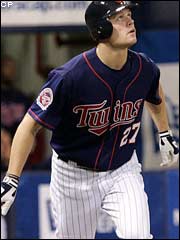 Justin Morneau - 2006 AL MVP
Tuesday, November 21, 2006
33 is MVP
Color me tickled. All indications had been pointing to Derek Jeter , but the results were announced today and Justin Morneau has captured the 2006 AL MVP, becoming the first Twin to win the award since Rod Carew all the way back in 1977.
We'll have a more detailed analysis for tomorrow.
We'll have a more detailed analysis for tomorrow.
Turkey Notes
There hasn't been a whole lot of news on the Twins as of late, but I felt I'd drop in an update here with a few quick notes as Thanksgiving Day rapidly approaches.
* I tend to avoid the urge to criticize the writing of Kelly Thesier, a reporter employed by MLB.com who writes most of the articles found on the Twins' official site. She draws some aspersion from bloggers for her tendency to write puffy and overly optimistic material, but as a Mass Communications major I understand that the goal of PR is to make your product look as attractive and flawless as possible. She's going to put a rosey-colored spin on everything she writes, and that's her job so I really have no problem with it.
However, sometimes I get a little exasperated when she writes things are blatantly untrue and not even defendable by the logic I described above. For instance, I came across this nugget today when reading an article about the Twins finalizing their 40-man roster for the off-season:
* The latest hot rumor is that Terry Ryan is in talks with the Rockies about a possible trade that would send right-handed starter Jason Jennings to the Twins. The names being tossed around on the Twins' side are Scott Baker and Jesse Crain, as the Rockies are reportedly looking for youthful rotation and bullpen help. The Twins have enough starters better than Baker and enough relievers better than Crain that I don't feel like losing them would be a significant blow. With that said, the prospect of this transaction is far from appealing to me.
Jennings was the NL Rookie of the Year in 2002 and he had a successful season in 2006, posting a 3.78 ERA over 212 innings in Colorado. He's also reasonably young at 28 and his salary in 2007 will be $5.5 million, which is relatively modest considering how much some middle-of-the-rotation starters have been signing for recently. However, looking past Jennings' nice ERA, there are plenty of reasons to believe his success in '06 was something of a fluke. For one thing, his ERA in each of the three prior seasons was over 5. For another thing, his peripherals were underwhelming. He didn't strike many batters out, his control was not good, and his groundball/flyball ratio was unimpressive. Couple that with the reality that he would almost certainly be gone following next season, and Jennings really doesn't appear to be worth a couple of fairly valuable trading chips.
* The AL MVP will be announced today. I'm fairly certain it will be Derek Jeter, but Justin Morneau stands a good chance of coming in second. I maintain that Morneau was the third-most valuable player on the Twins this season, but I'd certainly be happy to see him receive a bunch of votes. Of course, I also maintain that Albert Pujols was a much more valuable player than Ryan Howard in the NL, but hey, what do I know.
Happy Thanksgiving!
* I tend to avoid the urge to criticize the writing of Kelly Thesier, a reporter employed by MLB.com who writes most of the articles found on the Twins' official site. She draws some aspersion from bloggers for her tendency to write puffy and overly optimistic material, but as a Mass Communications major I understand that the goal of PR is to make your product look as attractive and flawless as possible. She's going to put a rosey-colored spin on everything she writes, and that's her job so I really have no problem with it.
However, sometimes I get a little exasperated when she writes things are blatantly untrue and not even defendable by the logic I described above. For instance, I came across this nugget today when reading an article about the Twins finalizing their 40-man roster for the off-season:
Of the four added on Monday, the most touted prospect would be the 22-year-old [Denard] Span. The outfielder has been talked about as the future replacement for Torii Hunter in center field as he possesses similar skills to the All-Star outfielder.Aside from the fact that they both play the same position and both are considered to be good defensive players, there are very few similarities between Torii Hunter and Denard Span. Hunter is right-handed, Span is left-handed. Hunter has considerable power, Span has almost none. Hunter is reasonably fast, Span's entire game is built around his incredible speed. Hunter strikes out frequently, Span is a contact hitter who generally puts the ball in play. Saying that the two players possess "similar skills" is a major stretch in my mind. Of course, it's also a little questionable to refer to Hunter as an "All-Star outfielder" seeing as how his only All-Star appearance came four years ago, but that gets back to that overly optimistic PR stuff I was talking about earlier...
* The latest hot rumor is that Terry Ryan is in talks with the Rockies about a possible trade that would send right-handed starter Jason Jennings to the Twins. The names being tossed around on the Twins' side are Scott Baker and Jesse Crain, as the Rockies are reportedly looking for youthful rotation and bullpen help. The Twins have enough starters better than Baker and enough relievers better than Crain that I don't feel like losing them would be a significant blow. With that said, the prospect of this transaction is far from appealing to me.
Jennings was the NL Rookie of the Year in 2002 and he had a successful season in 2006, posting a 3.78 ERA over 212 innings in Colorado. He's also reasonably young at 28 and his salary in 2007 will be $5.5 million, which is relatively modest considering how much some middle-of-the-rotation starters have been signing for recently. However, looking past Jennings' nice ERA, there are plenty of reasons to believe his success in '06 was something of a fluke. For one thing, his ERA in each of the three prior seasons was over 5. For another thing, his peripherals were underwhelming. He didn't strike many batters out, his control was not good, and his groundball/flyball ratio was unimpressive. Couple that with the reality that he would almost certainly be gone following next season, and Jennings really doesn't appear to be worth a couple of fairly valuable trading chips.
* The AL MVP will be announced today. I'm fairly certain it will be Derek Jeter, but Justin Morneau stands a good chance of coming in second. I maintain that Morneau was the third-most valuable player on the Twins this season, but I'd certainly be happy to see him receive a bunch of votes. Of course, I also maintain that Albert Pujols was a much more valuable player than Ryan Howard in the NL, but hey, what do I know.
Happy Thanksgiving!
Thursday, November 16, 2006
Santana Wins AL Cy Young Award
In other news, the sun rose this morning.
I don't mean to downplay the significance of a Twins pitcher winning this coveted award, but considering how incredible Johan Santana's 2006 season was and how large the statistical gap between him and his competitors was by the end of the season, this outcome was never in doubt. Santana won unanimously, receiving all 28 first-place votes. His first Cy Young in 2004 also came by unanimous decision, and he joins Roger Clemens ('97 and '98), Pedro Martinez ('99 and 2000), Greg Maddux ('94 and '95) and Sandy Koufax ('63, '65, '66) as the only pitchers to win the award unanimously on multiple occasions. Not bad company.
Santana joins a list of 13 pitchers in baseball history who have won multiple Cy Young Awards. Of those 13, six are in the Hall of Fame and five (Martinez, Maddux, Clemens, Johnson, Tom Glavine) are still pitching.

Of course, I can't really approach this topic without bringing up the fact that this most certainly should be Santana's third consecutive Cy Young Award. I have talked to a number of Twins fans who have actually let themselves believe that Santana's 2005 season was a step down for him simply because of the fact that he didn't win the Cy Young, which shows the sad amount of power these postseason awards can have over even adamant fans who watch all the games. In reality, the '05 season was just business as usual for Santana.
Santana 2004: 228 IP, 20-6, 2.61 ERA, 265 K / 54 BB, OPP .192/.249/.315
Santana 2005: 231.2 IP, 16-7, 2.87 ERA, 235 K / 45 BB, OPP .210/.250/.346
Santana 2006: 233.2 IP, 19-5, 2.77 ERA, 245 K / 47 BB, OPP .216/.258/.360
It's unlikely that Johan will ever match that unbelievable 2004 campaign, but the reality is that Santana's 2005 and 2006 campaigns were nearly identical. The ERA was up slightly in '05, but opposing hitters actually fared worse overall against him in the year he failed to win the Cy Young. Santana's inability to capture the award in 2005 had less to do with better competition and more to do with his low win total which was almost entirely due to his team's complete offensive ineptitude that season. In any case, this is a topic that has been exhaustively covered so I'm not going to delve into it anymore. The fact is that Santana has consistently been the best pitcher in baseball over the past three years and he's showing no signs of slowing down at age 27. Plus, he has pretty much never missed a start due to injury over those three years, which is extremely valuable when you look at all the injuries being sustained by pitchers around the league and even in the Twins' organization.
Finishing second in the AL Cy Young voting was Chien-Ming Wang, basically because he won 19 games. A more deserving second place finisher would have been Roy Halladay, who had an excellent season and finished a close third behind Wang. Fifth in the voting was Twins' closer Joe Nathan. While I'm glad to see his name in the voting results, I'm a little disappointed he didn't get more recognition. In 2005, Mariano Rivera finished second in the Cy Young voting (ahead of Santana) by saving 43 games in 47 opportunities and posting a 1.38 ERA while holding opponents to a .177 average. In '06, Nathan was 36/38 in save opportunities and he posted a 1.58 ERA and .158 opponents' batting average. Nathan also posted an incredible 95/16 strikeout-to-walk ratio this year, signficantly better than Rivera's 80/18 in 2005. I'm not saying that Nathan's 2006 season was better than Rivera's 2005, but it's at least very close and I'm disappointed that it received so little press. Nathan wasn't even the top finisher among closers in the Cy Young voting, as the Angels' Francisco Rodriguez landed ahead of him in fourth place despite being significantly worse in most categories (though not bad, by any means).
Clearly the Cy Young voting is faulty in many regards, but it's still fun to analyze the results because it truly is one of baseball's most recognizable and heralded awards. Twins fans and baseball fans alike have to be happy with the results this year, as the guy who should have won did so in dominant fashion.
Congratulations Johan on your second Cy Young. I think I speak for everyone when I say I doubt it will be your last.
I don't mean to downplay the significance of a Twins pitcher winning this coveted award, but considering how incredible Johan Santana's 2006 season was and how large the statistical gap between him and his competitors was by the end of the season, this outcome was never in doubt. Santana won unanimously, receiving all 28 first-place votes. His first Cy Young in 2004 also came by unanimous decision, and he joins Roger Clemens ('97 and '98), Pedro Martinez ('99 and 2000), Greg Maddux ('94 and '95) and Sandy Koufax ('63, '65, '66) as the only pitchers to win the award unanimously on multiple occasions. Not bad company.
Santana joins a list of 13 pitchers in baseball history who have won multiple Cy Young Awards. Of those 13, six are in the Hall of Fame and five (Martinez, Maddux, Clemens, Johnson, Tom Glavine) are still pitching.
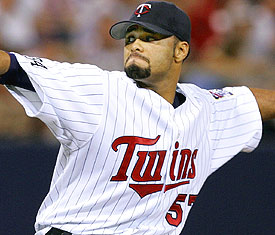
Of course, I can't really approach this topic without bringing up the fact that this most certainly should be Santana's third consecutive Cy Young Award. I have talked to a number of Twins fans who have actually let themselves believe that Santana's 2005 season was a step down for him simply because of the fact that he didn't win the Cy Young, which shows the sad amount of power these postseason awards can have over even adamant fans who watch all the games. In reality, the '05 season was just business as usual for Santana.
Santana 2004: 228 IP, 20-6, 2.61 ERA, 265 K / 54 BB, OPP .192/.249/.315
Santana 2005: 231.2 IP, 16-7, 2.87 ERA, 235 K / 45 BB, OPP .210/.250/.346
Santana 2006: 233.2 IP, 19-5, 2.77 ERA, 245 K / 47 BB, OPP .216/.258/.360
It's unlikely that Johan will ever match that unbelievable 2004 campaign, but the reality is that Santana's 2005 and 2006 campaigns were nearly identical. The ERA was up slightly in '05, but opposing hitters actually fared worse overall against him in the year he failed to win the Cy Young. Santana's inability to capture the award in 2005 had less to do with better competition and more to do with his low win total which was almost entirely due to his team's complete offensive ineptitude that season. In any case, this is a topic that has been exhaustively covered so I'm not going to delve into it anymore. The fact is that Santana has consistently been the best pitcher in baseball over the past three years and he's showing no signs of slowing down at age 27. Plus, he has pretty much never missed a start due to injury over those three years, which is extremely valuable when you look at all the injuries being sustained by pitchers around the league and even in the Twins' organization.
Finishing second in the AL Cy Young voting was Chien-Ming Wang, basically because he won 19 games. A more deserving second place finisher would have been Roy Halladay, who had an excellent season and finished a close third behind Wang. Fifth in the voting was Twins' closer Joe Nathan. While I'm glad to see his name in the voting results, I'm a little disappointed he didn't get more recognition. In 2005, Mariano Rivera finished second in the Cy Young voting (ahead of Santana) by saving 43 games in 47 opportunities and posting a 1.38 ERA while holding opponents to a .177 average. In '06, Nathan was 36/38 in save opportunities and he posted a 1.58 ERA and .158 opponents' batting average. Nathan also posted an incredible 95/16 strikeout-to-walk ratio this year, signficantly better than Rivera's 80/18 in 2005. I'm not saying that Nathan's 2006 season was better than Rivera's 2005, but it's at least very close and I'm disappointed that it received so little press. Nathan wasn't even the top finisher among closers in the Cy Young voting, as the Angels' Francisco Rodriguez landed ahead of him in fourth place despite being significantly worse in most categories (though not bad, by any means).
Clearly the Cy Young voting is faulty in many regards, but it's still fun to analyze the results because it truly is one of baseball's most recognizable and heralded awards. Twins fans and baseball fans alike have to be happy with the results this year, as the guy who should have won did so in dominant fashion.
Congratulations Johan on your second Cy Young. I think I speak for everyone when I say I doubt it will be your last.
Saturday, November 11, 2006
Trades and Bigger Trades
I'm sure most of you by now have heard the big news. Gary Sheffield was traded to the Detroit Tigers yesterday for three pitchers with fairly high ceilings. My wish was to make a post on the offseason outlook, name some needs, and indentify some possible trade partners. This trade obviously changes things. The Twins may have to become a little more desperate.
Naturally, a lot of people are going to point out that Sheffield had wrist surgery last year, and considering that he swings so hard with those wrists flailing away, there are no guarantees. That, and he's going to be 38 in just over a week. However, he is also the same hitter who has 455 career home runs and 1501 RBI. He's a very productive hitter and he may change the balance of the AL Central.
Needless to say, its apparent that Detroit wants to win now and not in the next few years. Does this mean the Twins should get more aggressive? I think they have to make at least a moderate trade and try and improve the team. The problem is that any time another AL Central team makes a fairly big trade (Chicago, Thome/Vazquez trades last offseason), the Twins don't do much to counter the balance of power. Sorry, but Luis Castillo doesn't exactly count.
So, what do the Twins need? Well, Nick Nelson identified DH, 3B, and SP as the big ones. I tend to agree. The problem is that starting pitcher is going to be overvalued right now and DHs are easier to sign as free agents then trade for. Look at all the potential DHs on the market: Moises Alou, Mike Piazza, Shea Hillenbrand, Aubrey Huff, and of course Mr. Bonds.
Personally, out of those, I would think Alou and Piazza are the best options. Bonds is unrealistic and Hillenbrand and Huff aren't terribly productive hitters. Hillenbrand hits for a decent average, but his power is limited and he never walks. We have enough of those guys. Alou and Piazza aren't the most patient guys either, but better than Hillebrand. Also, Piazza slugged .564 against the home-run-killing Petco Park in 2006 and a .283/.342/.501 line isn't bad at all.
Alou, because he's 40, isn't going to make big money. For a couple million, a career .301 hitter who has maintained his power in old age isn't bad at all. After all, in just 345 at-bats in 2006, Alou his .301 with 22 HRs and 74 RBI and slugged .571. I think he would make a great DH and he could play the outfield if entirely necessary.
As for trades, the Twins should probably concentrate on a middle infield. Unfortunate for them, the Indians already snatched Josh Bartfield from the Indians a older prospect who is better off being a DH.
The problem with third baseman is that, for one, the Twins appear to love Nick Punto at third, despite the fact he's probably better at second (for his offense) taking over for Castillo. Also, the Twins aren't exactly filled with options. I'm sure they'd love to trade for Alex Rodriguez or Miguel Cabrera, but those are pipedreams. Its not going to happen. As far as realistic trades, about the only guys I can see available are Hank Blalock, and maybe Adrian Beltre or Eric Chavez.
I mention Beltre and Chavez because they are both can potentially be portrayed by their teams as disappointments. I'm not sure that would expect them to be traded and neither of the players is particularly cheap. As for Blalock, he also had a down year, hitting .266/.325/.401 with only 16 HRs and 89 RBI. After a breakout year in 2004, when he hit 32 HRs and drove in 110 runs, Blalock has had to straight disappoiting years. If Texas did try and trade him, the price on Blalock would be down significantly and I believe it would be a trade the Twins could easily pull off.
As for starting pitching, I doubt the Twins will try to make any trades. This would be because the market for pitching is so high right now that they would be practically guaranteed to overpay, something Terry Ryan isn't likely to do. It would seem more likely for them to pick up a talented, but largely unsuccessful pitcher, like say Tony Armas, and see if the Rick Anderson program has the same magic it did on Dennys Reyes.
As a Twins fan, I'd love to see the Twins get aggressive, but in a market that looks to value the needs of the Twins very highly, I am not sure its likely. I expect most of their needs to get filled with bargain free agents and with internal candidates. Of course, I wouldn't mind the surprise of Alex Rodriguez on my team. Only New Yorkers are smart enough to undervalue such a good player.
Naturally, a lot of people are going to point out that Sheffield had wrist surgery last year, and considering that he swings so hard with those wrists flailing away, there are no guarantees. That, and he's going to be 38 in just over a week. However, he is also the same hitter who has 455 career home runs and 1501 RBI. He's a very productive hitter and he may change the balance of the AL Central.
Needless to say, its apparent that Detroit wants to win now and not in the next few years. Does this mean the Twins should get more aggressive? I think they have to make at least a moderate trade and try and improve the team. The problem is that any time another AL Central team makes a fairly big trade (Chicago, Thome/Vazquez trades last offseason), the Twins don't do much to counter the balance of power. Sorry, but Luis Castillo doesn't exactly count.
So, what do the Twins need? Well, Nick Nelson identified DH, 3B, and SP as the big ones. I tend to agree. The problem is that starting pitcher is going to be overvalued right now and DHs are easier to sign as free agents then trade for. Look at all the potential DHs on the market: Moises Alou, Mike Piazza, Shea Hillenbrand, Aubrey Huff, and of course Mr. Bonds.
Personally, out of those, I would think Alou and Piazza are the best options. Bonds is unrealistic and Hillenbrand and Huff aren't terribly productive hitters. Hillenbrand hits for a decent average, but his power is limited and he never walks. We have enough of those guys. Alou and Piazza aren't the most patient guys either, but better than Hillebrand. Also, Piazza slugged .564 against the home-run-killing Petco Park in 2006 and a .283/.342/.501 line isn't bad at all.
Alou, because he's 40, isn't going to make big money. For a couple million, a career .301 hitter who has maintained his power in old age isn't bad at all. After all, in just 345 at-bats in 2006, Alou his .301 with 22 HRs and 74 RBI and slugged .571. I think he would make a great DH and he could play the outfield if entirely necessary.
As for trades, the Twins should probably concentrate on a middle infield. Unfortunate for them, the Indians already snatched Josh Bartfield from the Indians a older prospect who is better off being a DH.
The problem with third baseman is that, for one, the Twins appear to love Nick Punto at third, despite the fact he's probably better at second (for his offense) taking over for Castillo. Also, the Twins aren't exactly filled with options. I'm sure they'd love to trade for Alex Rodriguez or Miguel Cabrera, but those are pipedreams. Its not going to happen. As far as realistic trades, about the only guys I can see available are Hank Blalock, and maybe Adrian Beltre or Eric Chavez.
I mention Beltre and Chavez because they are both can potentially be portrayed by their teams as disappointments. I'm not sure that would expect them to be traded and neither of the players is particularly cheap. As for Blalock, he also had a down year, hitting .266/.325/.401 with only 16 HRs and 89 RBI. After a breakout year in 2004, when he hit 32 HRs and drove in 110 runs, Blalock has had to straight disappoiting years. If Texas did try and trade him, the price on Blalock would be down significantly and I believe it would be a trade the Twins could easily pull off.
As for starting pitching, I doubt the Twins will try to make any trades. This would be because the market for pitching is so high right now that they would be practically guaranteed to overpay, something Terry Ryan isn't likely to do. It would seem more likely for them to pick up a talented, but largely unsuccessful pitcher, like say Tony Armas, and see if the Rick Anderson program has the same magic it did on Dennys Reyes.
As a Twins fan, I'd love to see the Twins get aggressive, but in a market that looks to value the needs of the Twins very highly, I am not sure its likely. I expect most of their needs to get filled with bargain free agents and with internal candidates. Of course, I wouldn't mind the surprise of Alex Rodriguez on my team. Only New Yorkers are smart enough to undervalue such a good player.
Monday, November 06, 2006
Francisco Tommy-John-o
Francisco Liriano went through with his Tommy John surgery today, and apparently the procedure went as planned and without any complications. The ligament replacement surgery was performed by Dr. Lewis Yokum, a specialist, and was assisted by Twins physician Dr. John Steubs. Now, Liriano will begin a long and difficult rehabilitation that will likely take anywhere from 12-18 months.
Despite the fact that Liriano's decision to go through with the surgery surfaced last week, we chose not to write about it here mostly because it was barely even news. Much like every other piece of "news" that has come out so far in the Twins' off-season (the team picking up Torii Hunter and Carlos Silva's 2007 options, Hunter winning a probably undeserved Gold Glove, Gardenhire's contract extension, etc.) this decision was not in any way surprising. The Twins had continued to insist that there was hope that Liriano could take care of his elbow issues with rest and exercise, but it was clear to most Twins fans that surgery was going to be necessary when his second comeback attempt was halted in the third inning and Frisco slumped off the field.
In a way, the Twins come off looking a bit silly in this situation. Their "wait and see" attitude didn't make much sense over the past few months, and it makes even less sense now. If they would have gone through with the surgery back in August or September, Liriano may have been on track to pitch winterball in a year; now we'll have to cross our fingers and hope that he'll be ready to go for Spring Training 2008. Ultimately, I suppose that going through with the surgery is the pitcher's decision, but as an organization the Twins never seemed to take a firm stance and never seemed to show much urgency when talking about the situation.
As has been discussed elsewhere, the prognosis for a pitcher undergoing Tommy John surgery these days is pretty good. Most pitchers who have undergone the surgery and rehab have come back to pitch at least as well as they had beforehand. Some have even added bite to their fastball as a result of the procedure. Liriano's situation, however, makes a little weary, for a couple of reasons.
First of all, I don't think this is a cut-and-dry case of an ulnar collateral ligament causing all the problems. When his problems initially surfaced, there was a lot of talk about Liriano's elbow problems being rooted in his left shoulder. If that is truly the case, I doubt that this surgery will really solve Liriano's problems, unless he is able to additionally strengthen the shoulder during his rehab period.
Secondly, Liriano's delivery puts a lot of strain on his elbow and I think there is legitimate reason for concern that this will continue to be a problem even after the surgery and rehab. There are a few pitchers who have had to undergo the TJ surgery multiple times, and that is certainly not a path that Liriano will want to follow. Aside from the procedure and lengthy rehab, some mechanical adjustments may be necessary to ensure that the young left-hander can have a long and successful career.
As it stands, Liriano is still just 23 years old and there is a good chance that he will be able to join the long list of pitchers who have undergone Tommy John surgery and come back with great success. The issues I've laid out above will no doubt be on the forefront of the minds of the Twins' medical staff as they work to ease him back into the process of throwing from a mound over the next year or so. My hope is that no complications arise during that span and he can come back in 2008 with the same filthy stuff he showed in his brilliant rookie campaign. The now-certain loss of Liriano for the 2007 season is depressing, but if he can come back at full strength and join Johan Santana at the front of the Twins rotation in a couple years, we'll have a very entertaining team to watch in the final years of its Metrodome residence and into the new stadium era.
Despite the fact that Liriano's decision to go through with the surgery surfaced last week, we chose not to write about it here mostly because it was barely even news. Much like every other piece of "news" that has come out so far in the Twins' off-season (the team picking up Torii Hunter and Carlos Silva's 2007 options, Hunter winning a probably undeserved Gold Glove, Gardenhire's contract extension, etc.) this decision was not in any way surprising. The Twins had continued to insist that there was hope that Liriano could take care of his elbow issues with rest and exercise, but it was clear to most Twins fans that surgery was going to be necessary when his second comeback attempt was halted in the third inning and Frisco slumped off the field.
In a way, the Twins come off looking a bit silly in this situation. Their "wait and see" attitude didn't make much sense over the past few months, and it makes even less sense now. If they would have gone through with the surgery back in August or September, Liriano may have been on track to pitch winterball in a year; now we'll have to cross our fingers and hope that he'll be ready to go for Spring Training 2008. Ultimately, I suppose that going through with the surgery is the pitcher's decision, but as an organization the Twins never seemed to take a firm stance and never seemed to show much urgency when talking about the situation.
As has been discussed elsewhere, the prognosis for a pitcher undergoing Tommy John surgery these days is pretty good. Most pitchers who have undergone the surgery and rehab have come back to pitch at least as well as they had beforehand. Some have even added bite to their fastball as a result of the procedure. Liriano's situation, however, makes a little weary, for a couple of reasons.
First of all, I don't think this is a cut-and-dry case of an ulnar collateral ligament causing all the problems. When his problems initially surfaced, there was a lot of talk about Liriano's elbow problems being rooted in his left shoulder. If that is truly the case, I doubt that this surgery will really solve Liriano's problems, unless he is able to additionally strengthen the shoulder during his rehab period.
Secondly, Liriano's delivery puts a lot of strain on his elbow and I think there is legitimate reason for concern that this will continue to be a problem even after the surgery and rehab. There are a few pitchers who have had to undergo the TJ surgery multiple times, and that is certainly not a path that Liriano will want to follow. Aside from the procedure and lengthy rehab, some mechanical adjustments may be necessary to ensure that the young left-hander can have a long and successful career.
As it stands, Liriano is still just 23 years old and there is a good chance that he will be able to join the long list of pitchers who have undergone Tommy John surgery and come back with great success. The issues I've laid out above will no doubt be on the forefront of the minds of the Twins' medical staff as they work to ease him back into the process of throwing from a mound over the next year or so. My hope is that no complications arise during that span and he can come back in 2008 with the same filthy stuff he showed in his brilliant rookie campaign. The now-certain loss of Liriano for the 2007 season is depressing, but if he can come back at full strength and join Johan Santana at the front of the Twins rotation in a couple years, we'll have a very entertaining team to watch in the final years of its Metrodome residence and into the new stadium era.
Friday, November 03, 2006
Potential Free Agent Targets
With the World Series in the rearview mirror and the time for off-season transactions steadily approaching, it's about time to start previewing the Twins' off-season needs and some potential targets via both free agency and trade. Today I will be taking a look at a list of players who have filed for free agency and may fit into the Twins' plans considering their needs and financial flexibility.
Unless something changes, there are three positions where Terry Ryan might be looking to shop during the off-season: SP, 3B, and DH. This list is, of course, liable to change.
For instance, the Twins might look internally for an answer at designated hitter, either by activating the 2007 option on Rondell White based on his good second half, or by bringing back Phil Nevin for another season. Ron Gardenhire might also opt to continue his trend of platooning Jason Tyner at DH next season, but let's hope not. Third base is also not necessarily a position where Ryan will aggressively look to upgrade in the coming months; Nick Punto had a good season there and deserves a lot of credit for the team's turnaround. With that said, his numbers outside of the month of July were not very good and it's unlikely he'll be able to put up such nice overall numbers next season. I think Ryan realizes that if he has the chance to get a good player there, it needs to be done.
Other positions might enter the off-season upgrade list as well. Left field is one that jumps out at me, because I'm not sure if either White or Tyner is really a permanent answer there. The hope is that Jason Kubel will be ready to take over this position in '07, but after the disappointing and injury-hampered season he had in 2006, it is far from a guarantee.
Looking through a list of potential free agents during the 2006-07 off-season, here are some names that stood out to me as possible targets for Ryan and the Twins:
STARTING PITCHER
Ted Lilly, 30
Lilly would be a nice southpaw to complement Johan Santana in the Twins' rotation with Francisco Liriano likely out for '07. Lilly has pretty good stuff and has posted a good ERA in three of the past four years. His peripherals aren't dazzling, but I could see him having Kenny Rogers-type success in the Twins' rotation.
Vicente Padilla, 29
Padilla has been a pretty good pitcher over the course of his career. Last year he gave the Rangers 200 innings at a 4.50 ERA, which would be more than sufficient for the No. 3 or 4 spot in the Twins' rotation. I have heard rumors, however, that Padilla might be looking for as much as $8-$9 million in free agency, which is far more than the Twins should or will spend.
Adam Eaton, 29
Eaton had a down year in 2006 when he was in Texas, but who doesn't? He was a solid pitcher in San Diego, and he strikes me as the type of pitcher Rick Anderson could work with. If his asking price is a little less than what he made in Texas last year ($4.65 million), I think he'd be a nice addition to the Twins' rotation. I'd certainly prefer him to Carlos Silva at that price.
Jeff Suppan, 31
Suppan has been fairly average over the course of his career, with a 106-101 career record to go along with a 4.60 ERA, but he's always been an "innings-eater," which is apparently a very desirable trait in a free agent pitcher. Suppan falls into the same category as most of the other pitchers mentioned here; he'd be a fine fit as a middle-to-bottom of the rotation guy, but it would be unwise to overspend on him because he's really nothing special.
Jeff Weaver, 30
I'm not going to sugarcoat my feelings about Weaver. I'm not a fan, at all. I think he's been wildly overrated for much of his career, and I was flabbergasted when the Angels saw fit to sign him for $8 million last winter. Weaver is one of those innings-eater guys, but he's just not all that good. He hasn't posted an ERA under 4 since 2002, and he is generally fairly hittable and homer-prone. He is also represented by Scott Boras, which provides further motivation to steer clear.
Gil Meche, 28
Meche is an intriguing player to me. He posted a 3.78 ERA in 2000, but before the 2001 season he had to undergo arthroscopic surgery to repair a frayed rotator cuff, and he wasn't able to return to the mound until 2003. In the four seasons since his return, he hasn't been quite the same. There are some encouraging signs with Meche though. He pitched a career-high 186 2/3 innings last season and his 4.48 ERA was the best of his career outside of that 2000 campaign. If the price is right, Meche could be a sneaky good pick-up.
Tony Armas, Jr., 28
There aren't many great things to say about Armas, but he might be a decent candidate to fill a spot in the bottom of the rotation at a reasonable price. Armas has a 4.45 career ERA and he's never posted a winning record in a season (except in an injury-shortened 2003 when he went 2-1 with the Expos). Last year, he was 9-12 with a 5.03 ERA and a 1.50 WHIP. He's not a great strikeout pitcher and he doesn't have great control. With that said, he's relatively young and he's managed to keep his ERA under 5 throughout his career up until last year.
SP CONCLUSIONS:
Barry Zito is going to be the big name in terms of free agent pitchers this off-season, but behind him there are a number of solid middle-of-the-rotation types that might interest the Twins. Ryan has voiced a desire to bring in a veteran that he can plug into the third or fourth slot in the rotation, so I fully expect him to get into the bidding with one of the guys mentioned above, or possibly another pitcher I didn't mention (Mark Redman, Randy Wolf, Jason Marquis, Aaron Sele, etc.).
DESIGNATED HITTER
Mike Piazza, 38
Despite the fact that he had an excellent season, hitting .283/.342/.501 with 22 homers and 68 RBI, the Padres declined their 2007 option on Piazza, making him a free agent. Piazza has been a great hitter for his entire career, with a lifetime hitting line of .309/.379/.551. He might not have the power he had five years ago, but he proved with his 2006 campaign that he can still hit despite the fact that he's climbing into his late 30s. If he'd be willing to give up catching and settle into a full-time DH role, I believe he'd be a great fit for the Twins, presuming he'd be willing to sign for something around the $2 million he signed for last year with San Diego.
Frank Thomas, 38
The Twins might have missed the boat on Thomas when they decided against pursuing him on the cheap last year due to injury concerns. Thomas, of course, had a monster year for the Athletics and helped power them past the Twins in the first round of the playoffs, and you'd better believe he'll be asking for a little more than $500K this winter. Reports from Oakland are that Thomas and the A's are close a multi-year deal, but if that doesn't happen, he's a guy something the Twins should look into.
Nomar Garciaparra, 33
Garciaparra won the NL Comeback Player of the Year Award in 2006 by hitting .303/.367/.505 with 20 HR and 93 RBI, but because of the fact that he's still only 33 and a fairly valuable defensive player, it's not particularly likely that he'd accept a DH role. It's also likely that he'll demand a pretty penny in free agency because of those nice numbers.
DH CONCLUSIONS:
The trend here seems to be players that the Twins could have pursued in the last off-season, but chose not to for various reasons. Now, they're all back and at higher price tags. I would not rate the likelihood of the Twins landing any of these players as particularly high, but any one of them would be a nice fit between those big left-handed bats in the Twins' lineup and acquiring a big name might help increase fan interest. Of course, if they wanted the biggest name, they could take a look at that guy from San Francisco who recently filed for FA...
THIRD BASE
Pedro Feliz, 31
Feliz, who has spent his entire seven-year major-league career with the Giants, has always been an overrated player in my mind. He's a mediocre fielder with 20 HR-type power who holds a meager .252 career batting average. Last season, he hit just .244 with a Batista-esque .281 on-base percentage, although he did manage to hit 22 homers and drive in a career-high 98 runs. Feliz made $4 million with the Giants last year, and I don't think he's worth that; if he's asking for a raise the Twins should promptly look elsewhere.
Rich Aurilia, 35
At 35, Aurilia would be a very temporary fix for the Twins. With that said, he might be the most attractive third base option among the free agent batch this year. It appeared that Aurilia's career was dying down when he hit .246/.314/.353 between the Mariners and Padres in 2004, leading some to believe that he was incapable of putting up numbers without being in same lineup as Barry Bonds. However, Aurilia has been resurgent in his two seasons in Cincinnati, and last year he hit .300/.349/.518 with 23 home runs and 70 RBI. His right-handedness would make him a good fit in the Twins' lineup, and he was playing for fairly cheap in Cincy, although I'm not sure what he'll demand in free agency.
Aubrey Huff, 29
I thought Huff would have been a decent trade candidate for the Twins last season, because he's got some nice power and he's a versatile fielder who can play first base, third base, and the corner outfield positions. However, to say he's a versatile fielder is not to say he's a particularly good fielder at any of those positions. Between Tampa Bay and Houston last year, he hit .267 with 21 home runs and 66 RBI. Not bad, but nothing spectacular. He'll turn 30 next month and he made almost $7 million last year, which means he's probably not financially feasible for the Twins. The fact that he bats left-handed adds to the unlikelihood that Ryan will give him a look.
Aaron Boone, 33
Boone had some success with the Reds early in his career, and was an All-Star back in 2003. Sadly, he has fallen off the map over the past couple of seasons, and has failed to post an OPS over .700 since '03. Boone is a solid defender with some occasional pop in his bat, but his .264/.325/.429 career line is mediocre and it's been in steady decline since he left Cincinnati. Not a likely candidate.
Tony Batista, 32
Come on, he deserves another shot... right?
3B CONCLUSIONS:
When you take into account price and age, I don't see a definitive upgrade over Punto among these players. The only guy in the free agent market at third base who would look a lot better than Punto would be Aramis Ramirez, and I somehow doubt the Twins are looking to shell out the necessary $15 million in free agency. If Ryan wants to upgrade at third base, he may have to look to the trade market to do so.
Unless something changes, there are three positions where Terry Ryan might be looking to shop during the off-season: SP, 3B, and DH. This list is, of course, liable to change.
For instance, the Twins might look internally for an answer at designated hitter, either by activating the 2007 option on Rondell White based on his good second half, or by bringing back Phil Nevin for another season. Ron Gardenhire might also opt to continue his trend of platooning Jason Tyner at DH next season, but let's hope not. Third base is also not necessarily a position where Ryan will aggressively look to upgrade in the coming months; Nick Punto had a good season there and deserves a lot of credit for the team's turnaround. With that said, his numbers outside of the month of July were not very good and it's unlikely he'll be able to put up such nice overall numbers next season. I think Ryan realizes that if he has the chance to get a good player there, it needs to be done.
Other positions might enter the off-season upgrade list as well. Left field is one that jumps out at me, because I'm not sure if either White or Tyner is really a permanent answer there. The hope is that Jason Kubel will be ready to take over this position in '07, but after the disappointing and injury-hampered season he had in 2006, it is far from a guarantee.
Looking through a list of potential free agents during the 2006-07 off-season, here are some names that stood out to me as possible targets for Ryan and the Twins:
STARTING PITCHER
Ted Lilly, 30
Lilly would be a nice southpaw to complement Johan Santana in the Twins' rotation with Francisco Liriano likely out for '07. Lilly has pretty good stuff and has posted a good ERA in three of the past four years. His peripherals aren't dazzling, but I could see him having Kenny Rogers-type success in the Twins' rotation.
Vicente Padilla, 29
Padilla has been a pretty good pitcher over the course of his career. Last year he gave the Rangers 200 innings at a 4.50 ERA, which would be more than sufficient for the No. 3 or 4 spot in the Twins' rotation. I have heard rumors, however, that Padilla might be looking for as much as $8-$9 million in free agency, which is far more than the Twins should or will spend.
Adam Eaton, 29
Eaton had a down year in 2006 when he was in Texas, but who doesn't? He was a solid pitcher in San Diego, and he strikes me as the type of pitcher Rick Anderson could work with. If his asking price is a little less than what he made in Texas last year ($4.65 million), I think he'd be a nice addition to the Twins' rotation. I'd certainly prefer him to Carlos Silva at that price.
Jeff Suppan, 31
Suppan has been fairly average over the course of his career, with a 106-101 career record to go along with a 4.60 ERA, but he's always been an "innings-eater," which is apparently a very desirable trait in a free agent pitcher. Suppan falls into the same category as most of the other pitchers mentioned here; he'd be a fine fit as a middle-to-bottom of the rotation guy, but it would be unwise to overspend on him because he's really nothing special.
Jeff Weaver, 30
I'm not going to sugarcoat my feelings about Weaver. I'm not a fan, at all. I think he's been wildly overrated for much of his career, and I was flabbergasted when the Angels saw fit to sign him for $8 million last winter. Weaver is one of those innings-eater guys, but he's just not all that good. He hasn't posted an ERA under 4 since 2002, and he is generally fairly hittable and homer-prone. He is also represented by Scott Boras, which provides further motivation to steer clear.
Gil Meche, 28
Meche is an intriguing player to me. He posted a 3.78 ERA in 2000, but before the 2001 season he had to undergo arthroscopic surgery to repair a frayed rotator cuff, and he wasn't able to return to the mound until 2003. In the four seasons since his return, he hasn't been quite the same. There are some encouraging signs with Meche though. He pitched a career-high 186 2/3 innings last season and his 4.48 ERA was the best of his career outside of that 2000 campaign. If the price is right, Meche could be a sneaky good pick-up.
Tony Armas, Jr., 28
There aren't many great things to say about Armas, but he might be a decent candidate to fill a spot in the bottom of the rotation at a reasonable price. Armas has a 4.45 career ERA and he's never posted a winning record in a season (except in an injury-shortened 2003 when he went 2-1 with the Expos). Last year, he was 9-12 with a 5.03 ERA and a 1.50 WHIP. He's not a great strikeout pitcher and he doesn't have great control. With that said, he's relatively young and he's managed to keep his ERA under 5 throughout his career up until last year.
SP CONCLUSIONS:
Barry Zito is going to be the big name in terms of free agent pitchers this off-season, but behind him there are a number of solid middle-of-the-rotation types that might interest the Twins. Ryan has voiced a desire to bring in a veteran that he can plug into the third or fourth slot in the rotation, so I fully expect him to get into the bidding with one of the guys mentioned above, or possibly another pitcher I didn't mention (Mark Redman, Randy Wolf, Jason Marquis, Aaron Sele, etc.).
DESIGNATED HITTER
Mike Piazza, 38
Despite the fact that he had an excellent season, hitting .283/.342/.501 with 22 homers and 68 RBI, the Padres declined their 2007 option on Piazza, making him a free agent. Piazza has been a great hitter for his entire career, with a lifetime hitting line of .309/.379/.551. He might not have the power he had five years ago, but he proved with his 2006 campaign that he can still hit despite the fact that he's climbing into his late 30s. If he'd be willing to give up catching and settle into a full-time DH role, I believe he'd be a great fit for the Twins, presuming he'd be willing to sign for something around the $2 million he signed for last year with San Diego.
Frank Thomas, 38
The Twins might have missed the boat on Thomas when they decided against pursuing him on the cheap last year due to injury concerns. Thomas, of course, had a monster year for the Athletics and helped power them past the Twins in the first round of the playoffs, and you'd better believe he'll be asking for a little more than $500K this winter. Reports from Oakland are that Thomas and the A's are close a multi-year deal, but if that doesn't happen, he's a guy something the Twins should look into.
Nomar Garciaparra, 33
Garciaparra won the NL Comeback Player of the Year Award in 2006 by hitting .303/.367/.505 with 20 HR and 93 RBI, but because of the fact that he's still only 33 and a fairly valuable defensive player, it's not particularly likely that he'd accept a DH role. It's also likely that he'll demand a pretty penny in free agency because of those nice numbers.
DH CONCLUSIONS:
The trend here seems to be players that the Twins could have pursued in the last off-season, but chose not to for various reasons. Now, they're all back and at higher price tags. I would not rate the likelihood of the Twins landing any of these players as particularly high, but any one of them would be a nice fit between those big left-handed bats in the Twins' lineup and acquiring a big name might help increase fan interest. Of course, if they wanted the biggest name, they could take a look at that guy from San Francisco who recently filed for FA...
THIRD BASE
Pedro Feliz, 31
Feliz, who has spent his entire seven-year major-league career with the Giants, has always been an overrated player in my mind. He's a mediocre fielder with 20 HR-type power who holds a meager .252 career batting average. Last season, he hit just .244 with a Batista-esque .281 on-base percentage, although he did manage to hit 22 homers and drive in a career-high 98 runs. Feliz made $4 million with the Giants last year, and I don't think he's worth that; if he's asking for a raise the Twins should promptly look elsewhere.
Rich Aurilia, 35
At 35, Aurilia would be a very temporary fix for the Twins. With that said, he might be the most attractive third base option among the free agent batch this year. It appeared that Aurilia's career was dying down when he hit .246/.314/.353 between the Mariners and Padres in 2004, leading some to believe that he was incapable of putting up numbers without being in same lineup as Barry Bonds. However, Aurilia has been resurgent in his two seasons in Cincinnati, and last year he hit .300/.349/.518 with 23 home runs and 70 RBI. His right-handedness would make him a good fit in the Twins' lineup, and he was playing for fairly cheap in Cincy, although I'm not sure what he'll demand in free agency.
Aubrey Huff, 29
I thought Huff would have been a decent trade candidate for the Twins last season, because he's got some nice power and he's a versatile fielder who can play first base, third base, and the corner outfield positions. However, to say he's a versatile fielder is not to say he's a particularly good fielder at any of those positions. Between Tampa Bay and Houston last year, he hit .267 with 21 home runs and 66 RBI. Not bad, but nothing spectacular. He'll turn 30 next month and he made almost $7 million last year, which means he's probably not financially feasible for the Twins. The fact that he bats left-handed adds to the unlikelihood that Ryan will give him a look.
Aaron Boone, 33
Boone had some success with the Reds early in his career, and was an All-Star back in 2003. Sadly, he has fallen off the map over the past couple of seasons, and has failed to post an OPS over .700 since '03. Boone is a solid defender with some occasional pop in his bat, but his .264/.325/.429 career line is mediocre and it's been in steady decline since he left Cincinnati. Not a likely candidate.
Tony Batista, 32
Come on, he deserves another shot... right?
3B CONCLUSIONS:
When you take into account price and age, I don't see a definitive upgrade over Punto among these players. The only guy in the free agent market at third base who would look a lot better than Punto would be Aramis Ramirez, and I somehow doubt the Twins are looking to shell out the necessary $15 million in free agency. If Ryan wants to upgrade at third base, he may have to look to the trade market to do so.
Tuesday, October 31, 2006
Silva's '07 Option Picked Up
In the spirit of Halloween, the Twins are doing their best to horrify fans, as they announced this afternoon that they have picked up Carlos Silva's $4.35 option for 2007. Silva was downright painful to watch this season, posting numbers that ranked among baseball's worst in almost every major category. And now, for that performance, he will be receiving a raise of more than $1 million to come back next season.
It's difficult to be overly critical of Terry Ryan and the Twins for making this move, because their hand was forced to a great degree. If Francisco Liriano was healthy and locked in as a starter for next season, and if Brad Radke wasn't almost certain to retire, it's entirely possible the Twins would have parted ways with the 27-year-old Silva rather than grossly overpaying him for what will likely be another sub par season. The fact is that Johan Santana and Boof Bonser are the only sure things heading into the off-season; Scott Baker had a highly disappointing season in '06 and Matt Garza failed to prove himself as a bona fide member of the rotation. Even with Silva coming back, it's likely that the Twins will still be in the market for another veteran starter during the offseason so that they won't be forced to rely on two inexperienced and inconsistent youngsters at the bottom of the rotation.
Declaring Silva worthless might be a bit premature. We cannot forget that Silva was very good in 2005, posting a winning record and a very good 3.44 ERA. With that said, his 2006 season was an absolutely disaster and it's really difficult to see him returning to form after the way he struggled all year long. He's a pitcher that treads a dangerous line: a sinker-baller with almost no ability to strike out opposing batters, who must induce groundballs to have any success. As we saw this season, the ability to force opposing hitters to put the ball on the ground is a skill that comes and goes and if he doesn't have it, he's basically throwing BP.
The Twins' decision to pick up Silva's option is no treat, and sadly it's probably not a trick either. The team is simply low on arms in the rotation, and they have to go with the guy who has some experience. The fact that he'll be eating up almost $5 million in salary is disappointing, but that's just the way things work.
It's difficult to be overly critical of Terry Ryan and the Twins for making this move, because their hand was forced to a great degree. If Francisco Liriano was healthy and locked in as a starter for next season, and if Brad Radke wasn't almost certain to retire, it's entirely possible the Twins would have parted ways with the 27-year-old Silva rather than grossly overpaying him for what will likely be another sub par season. The fact is that Johan Santana and Boof Bonser are the only sure things heading into the off-season; Scott Baker had a highly disappointing season in '06 and Matt Garza failed to prove himself as a bona fide member of the rotation. Even with Silva coming back, it's likely that the Twins will still be in the market for another veteran starter during the offseason so that they won't be forced to rely on two inexperienced and inconsistent youngsters at the bottom of the rotation.
Declaring Silva worthless might be a bit premature. We cannot forget that Silva was very good in 2005, posting a winning record and a very good 3.44 ERA. With that said, his 2006 season was an absolutely disaster and it's really difficult to see him returning to form after the way he struggled all year long. He's a pitcher that treads a dangerous line: a sinker-baller with almost no ability to strike out opposing batters, who must induce groundballs to have any success. As we saw this season, the ability to force opposing hitters to put the ball on the ground is a skill that comes and goes and if he doesn't have it, he's basically throwing BP.
The Twins' decision to pick up Silva's option is no treat, and sadly it's probably not a trick either. The team is simply low on arms in the rotation, and they have to go with the guy who has some experience. The fact that he'll be eating up almost $5 million in salary is disappointing, but that's just the way things work.
Monday, October 30, 2006
Trade Review
If there's one thing Terry Ryan has shown a great knack for in his time as general manager of the Minnesota Twins, it's getting great value out of trades. While his track record in free agency may be far from spotless, he has been responsible for some of the most noteworthy trades of the last decade, which can often be described as nothing short of a "steal." While the A.J. Pierzynski trade that brought in Francisco Liriano, Joe Nathan and Boof Bonser may be his crowning achievement, you can't overlook the trades that produced players like Nick Punto, Jason Bartlett, and Shannon Stewart.
Now, I'll take a look at the major trades that Ryan made over the course of this season as well as the previous offseason, and an analysis of how they're looking so far. As you might have guessed, a couple are looking like definite steals.
Travis Bowyer and Scott Tyler to Florida for Luis Castillo
Ryan has generally made it a rule of thumb to avoid parting with good pitching prospects. He made an exception to this philosophy last offseason went he sent Bowyer, along with low-level prospect Tyler, to the Marlins in return for a veteran second baseman in Castillo.
Bowyer, a 20th-round draft pick by the Twins in 1999, was coming off an excellent 2005 campaign in which he posted a 2.78 ERA in 74 1/3 innings at the Triple-A level as a 24-year-old reliever. He struck out 96 and walked 40. The Marlins acquired him and it seemed that he could be the team's full-time closer as soon as this year. Unfortunately for Florida, Bowyer missed the entirety of the 2006 season with shoulder problems. He had surgery last month and is expected to miss the beginning of the 2007 season.
Tyler, on the other hand, had an interesting season in the Marlins' system. He also struggled with injuries at times, but did manage to throw 61 1/3 innings, all at the Double-A level. During that span, Tyler posted a solid 3.67 ERA but struggled mightily with his control, walking 44 batters while striking out 52. Because of this, Tyler posted an ugly 1.63 WHIP despite allowing just 56 hits in those 61.1 IP.
Castillo was not sensational in 2006, but he was a tremendous upgrade both offensively and defensively from anything the Twins have had at second base for the past several years. His batting line of .296/.358/.370 was right around his career averages (.293/.369/.358). While his patience was a little disappointing early in the season, he came around near the end and finished with a nearly even strikeout-to-walk ratio (58:56). Castillo also stole 25 bases and led the major leagues in infield hits, taking advantage of the Metrodome surface.
Even if you're not a huge fan of Castillo (which I wouldn't say I am), you have to like the way this trade has turned out for the Twins so far. It's too early to stick a fork in Bowyer, but his career prospects have definitely taken a major hit. As for Tyler, it's tough to visualize a guy who posted a 6.46 BB/9 IP in Double-A as having a particularly bright future.
J.C. Romero to Los Angeles Angels for Alexi Casilla
This was a more traditional Ryan trade, both in its make-up and in its results. Ryan traded a guy whose value was probably higher than it should have been for a prospect who was likely undervalued in his respective organization, and the result is what appears to have been a major steal.
Although he posted good numbers in 2005, it was fairly clear to anyone who watched the Twins that Romero had some serious issues. On the exterior, his 3.47 ERA and .235 BAA from that season looked pretty nice, but when you looked deeper there were some troubling peripherals. Romero's numbers were far worse in the second half of the season (4.94 ERA) than the first (2.43). He struggled greatly with his control against right-handed hitters (20 K, 29 BB). Also, it is well-documented that he was horrible at holding inherited runners on base.
This year, those problems ballooned for Romero in Los Angeles, and the results were disastrous: a 6.70 ERA, .298/.382/.450 opponents' line, and a 31:28 strikeout-to-walk ratio over 48.1 IP. Righties hit .382/.455/.578 against Romero.
Over in the Twins' organization, Casilla turned in an extremely impressive 2006 campaign. After hitting .331/.390/.406 over 78 games at Ft. Myers, he was bumped up to New Britain, where he hit .294/.375/.382 in 45 games. Between both levels, Casilla stole 50 bases while being caught just 10 times, and posted a solid 56:48 strikeout-to-walk ratio. His performance impressed the Twins so much that he earned a September call-up, during which he picked up one hit and two walks in six plate appearances.
Casilla has turned himself into the Twins' top infield prospect, while Romero has turned himself into a sub par LOOGY with no ability to get right-handed hitters out. On top of all that, the guy who the Twins signed to replace Romero as their lefty specialist, Dennys Reyes, was arguably the best southpaw reliever in baseball. Another great trade for the Twins.
Kyle Lohse to Cincinnati for Zac Ward
Ryan resisted the urge to trade Lohse at the deadline in 2005, and then did so again during the last offseason. These turned out to be grave mistakes. Lohse was absolutely horrible early in the season for the Twins, posting a 7.07 ERA before they traded him in late July. He pitched pretty well upon arriving in Cininnati, posting a 2.78 ERA in August, but then fell back into his old habits and finished up the season with a terrible 6.46 ERA in September. For the season as a whole, Lohse posted a career-worst 5.83 ERA and opponents hit .298/.358/.444 against him. Those numbers are not good, but they're not really off-line with his career norms (.285/.342/.453). Lohse just generally seems to get hit hard, which leads me to believe his prognosis in Cincinnati is not great. He is a pain in the clubhouse and he earns more money than he deserves, and now he's Wayne Krivsky's problem to deal with.
For his part, Ward struggled for the Twins, going 1-4 with a 5.93 ERA in six starts for Beloit. That's pretty disappointing, particularly since he had pitched so well (7-0, 2.29 ERA. 0.97 WHIP) for Cincinnati's Low-A affiliate in the first chunk of the season. Ward will turn 23 in January, which is starting to get a little old for a Low-A ball prospect. It's hard to predict what will become of him, but at the very least this trade was nice because it got Lohse's salary off the books.
Still, it's saddening to think about how much more Ryan could have gotten in return for him had he traded him earlier.
Juan Castro to Cincinnati for Brandon Roberts
I would not rank Castro as one of the better backup shortstops in the league, so the fact that he started for the Twins for almost three months is an embarrassing blemish on the judgment records of Ryan and Ron Gardenhire. Nonetheless, they eventually woke up and yanked him in the middle of June, around the same time they cut bait on the Tony Batista experiment. Those two players were replaced by Jason Bartlett and Nick Punto, and the rest, as they say, is history.
Since Castro was hitting .231/.258/.308 and nearing his 34th birthday when they traded him, anything the Twins got in return was going to be a bonus. That bonus turned out to be Roberts, a 21-year-old speedy outfielder playing for Sarasota, the Reds' High-A affiliate. When he came to the Twins organization, Roberts was hitting an unimpressive .267/.325/.308 in 60 games on the season. Once he started playing in Ft. Myers, however, Roberts broke out, hitting .316/.370/.396 in his 71 games there. Like Casilla, Roberts can terrorize on the basepaths; he stole 50 bases between Sarasota and Ft. Myers while being caught just 14 times. He doesn't have much discipline or power, but the high batting average and the stolen bases are encouraging for a young kid who is a versatile defender.
Castro did finish the year pretty well for the Reds, hitting .284/.320/.421 in 95 at-bats in Cincinnati, but I think it's safe to say the Twins didn't (and won't) miss him that much. This was another very good trade.
Now, I'll take a look at the major trades that Ryan made over the course of this season as well as the previous offseason, and an analysis of how they're looking so far. As you might have guessed, a couple are looking like definite steals.
Travis Bowyer and Scott Tyler to Florida for Luis Castillo
Ryan has generally made it a rule of thumb to avoid parting with good pitching prospects. He made an exception to this philosophy last offseason went he sent Bowyer, along with low-level prospect Tyler, to the Marlins in return for a veteran second baseman in Castillo.
Bowyer, a 20th-round draft pick by the Twins in 1999, was coming off an excellent 2005 campaign in which he posted a 2.78 ERA in 74 1/3 innings at the Triple-A level as a 24-year-old reliever. He struck out 96 and walked 40. The Marlins acquired him and it seemed that he could be the team's full-time closer as soon as this year. Unfortunately for Florida, Bowyer missed the entirety of the 2006 season with shoulder problems. He had surgery last month and is expected to miss the beginning of the 2007 season.
Tyler, on the other hand, had an interesting season in the Marlins' system. He also struggled with injuries at times, but did manage to throw 61 1/3 innings, all at the Double-A level. During that span, Tyler posted a solid 3.67 ERA but struggled mightily with his control, walking 44 batters while striking out 52. Because of this, Tyler posted an ugly 1.63 WHIP despite allowing just 56 hits in those 61.1 IP.
Castillo was not sensational in 2006, but he was a tremendous upgrade both offensively and defensively from anything the Twins have had at second base for the past several years. His batting line of .296/.358/.370 was right around his career averages (.293/.369/.358). While his patience was a little disappointing early in the season, he came around near the end and finished with a nearly even strikeout-to-walk ratio (58:56). Castillo also stole 25 bases and led the major leagues in infield hits, taking advantage of the Metrodome surface.
Even if you're not a huge fan of Castillo (which I wouldn't say I am), you have to like the way this trade has turned out for the Twins so far. It's too early to stick a fork in Bowyer, but his career prospects have definitely taken a major hit. As for Tyler, it's tough to visualize a guy who posted a 6.46 BB/9 IP in Double-A as having a particularly bright future.
J.C. Romero to Los Angeles Angels for Alexi Casilla
This was a more traditional Ryan trade, both in its make-up and in its results. Ryan traded a guy whose value was probably higher than it should have been for a prospect who was likely undervalued in his respective organization, and the result is what appears to have been a major steal.
Although he posted good numbers in 2005, it was fairly clear to anyone who watched the Twins that Romero had some serious issues. On the exterior, his 3.47 ERA and .235 BAA from that season looked pretty nice, but when you looked deeper there were some troubling peripherals. Romero's numbers were far worse in the second half of the season (4.94 ERA) than the first (2.43). He struggled greatly with his control against right-handed hitters (20 K, 29 BB). Also, it is well-documented that he was horrible at holding inherited runners on base.
This year, those problems ballooned for Romero in Los Angeles, and the results were disastrous: a 6.70 ERA, .298/.382/.450 opponents' line, and a 31:28 strikeout-to-walk ratio over 48.1 IP. Righties hit .382/.455/.578 against Romero.
Over in the Twins' organization, Casilla turned in an extremely impressive 2006 campaign. After hitting .331/.390/.406 over 78 games at Ft. Myers, he was bumped up to New Britain, where he hit .294/.375/.382 in 45 games. Between both levels, Casilla stole 50 bases while being caught just 10 times, and posted a solid 56:48 strikeout-to-walk ratio. His performance impressed the Twins so much that he earned a September call-up, during which he picked up one hit and two walks in six plate appearances.
Casilla has turned himself into the Twins' top infield prospect, while Romero has turned himself into a sub par LOOGY with no ability to get right-handed hitters out. On top of all that, the guy who the Twins signed to replace Romero as their lefty specialist, Dennys Reyes, was arguably the best southpaw reliever in baseball. Another great trade for the Twins.
Kyle Lohse to Cincinnati for Zac Ward
Ryan resisted the urge to trade Lohse at the deadline in 2005, and then did so again during the last offseason. These turned out to be grave mistakes. Lohse was absolutely horrible early in the season for the Twins, posting a 7.07 ERA before they traded him in late July. He pitched pretty well upon arriving in Cininnati, posting a 2.78 ERA in August, but then fell back into his old habits and finished up the season with a terrible 6.46 ERA in September. For the season as a whole, Lohse posted a career-worst 5.83 ERA and opponents hit .298/.358/.444 against him. Those numbers are not good, but they're not really off-line with his career norms (.285/.342/.453). Lohse just generally seems to get hit hard, which leads me to believe his prognosis in Cincinnati is not great. He is a pain in the clubhouse and he earns more money than he deserves, and now he's Wayne Krivsky's problem to deal with.
For his part, Ward struggled for the Twins, going 1-4 with a 5.93 ERA in six starts for Beloit. That's pretty disappointing, particularly since he had pitched so well (7-0, 2.29 ERA. 0.97 WHIP) for Cincinnati's Low-A affiliate in the first chunk of the season. Ward will turn 23 in January, which is starting to get a little old for a Low-A ball prospect. It's hard to predict what will become of him, but at the very least this trade was nice because it got Lohse's salary off the books.
Still, it's saddening to think about how much more Ryan could have gotten in return for him had he traded him earlier.
Juan Castro to Cincinnati for Brandon Roberts
I would not rank Castro as one of the better backup shortstops in the league, so the fact that he started for the Twins for almost three months is an embarrassing blemish on the judgment records of Ryan and Ron Gardenhire. Nonetheless, they eventually woke up and yanked him in the middle of June, around the same time they cut bait on the Tony Batista experiment. Those two players were replaced by Jason Bartlett and Nick Punto, and the rest, as they say, is history.
Since Castro was hitting .231/.258/.308 and nearing his 34th birthday when they traded him, anything the Twins got in return was going to be a bonus. That bonus turned out to be Roberts, a 21-year-old speedy outfielder playing for Sarasota, the Reds' High-A affiliate. When he came to the Twins organization, Roberts was hitting an unimpressive .267/.325/.308 in 60 games on the season. Once he started playing in Ft. Myers, however, Roberts broke out, hitting .316/.370/.396 in his 71 games there. Like Casilla, Roberts can terrorize on the basepaths; he stole 50 bases between Sarasota and Ft. Myers while being caught just 14 times. He doesn't have much discipline or power, but the high batting average and the stolen bases are encouraging for a young kid who is a versatile defender.
Castro did finish the year pretty well for the Reds, hitting .284/.320/.421 in 95 at-bats in Cincinnati, but I think it's safe to say the Twins didn't (and won't) miss him that much. This was another very good trade.
***
I decided not to review the Adam Harben-for-Phil Nevin trade in this article, because it's simply too early to make any judgments. If the Twins release Nevin during the offseason and Harben goes on to have a decent career, it will probably end up as a bad trade. On the flip side, the Twins might bring back Nevin for next year, and if Harben continues to pitch like he did this year for the rest of his career, the trade will look pretty nice.
The analysis of these trades is still early and subject to change, but at this point it's looking like another successful season for Terry Ryan in the trade department. I'll certainly be interested to see what he can pull off in the coming months.
The analysis of these trades is still early and subject to change, but at this point it's looking like another successful season for Terry Ryan in the trade department. I'll certainly be interested to see what he can pull off in the coming months.
Wednesday, October 25, 2006
No Surprises
It appears that after all the rhetoric the Twins office could spit out to explain or approach the situation otherwise, Francisco Liriano will probably have surgery of some sort on his elbow in the next week. This comes as no surprise to me, as he once again rested and tried to restrengthen his elbow, returned to the mound, and quickly found the pain reappearing.
Now, as I've written on here before, the program the Twins have Liriano on as a non-surgical option doesn't appear to even consider changing his mechanics or stopping him from throwing his slider, which puts the most violent stress on his elbow. If that's true, the Twins were very foolish in their approach.
Of course, it's pretty hard to know whether or not that happened. What we do know is despite the Twins repeating over and over again that the young pitcher and potential ace didn't need any surgery, he probably needs it now anyways. In the article I have linked, La Velle E. Neal writes that Liriano could have either an "exploratory operation" or Tommy-John surgery.
I have to believe the "exploratory operation" idea is unlikely and only comes up as a more positive alternative. If Liriano has Tommy-John surgery, he is all but out for next year. Much like micro-fracture surgery, Tommy-John has a long recovery time and there is no reason to expect him back for 2007.
I have to agree with Aaron Gleeman here. He thinks that this is not such a bad, not because losing him won't be a serious detriment to our chances in 2007, but because there is no point in taking more chances with a young pitcher with so much potential and an exciting future. Often, when pitchers have Tommy-John, they come back much stronger and sometimes even have a little extra on their fastball.
If you want proof, look no furter than last night's Game Three starter and winner, Chris Carpenter. Carpenter returned from the surgery, was throwing 96 MPH with his outstanding curve, and after returning with a good 2004 season, he won a Cy Young Award in 2005. In 645 1/3 innings since returning from surgery, he has allowed only 567 hits while strike out 543 and walking only 132. In that time, he is 51-18 with a 3.10 ERA.
Obviously, those are fairly impressive numbers. Carpenter is a good example of Tommy-John gone right. Joe Mays, for instance, is a guy who had the surgery and turned into a pumpkin immediately after. Of course, he was Joe Mays and after the surgery, he was still Joe Mays. Unfortunately, surgery wasn't going to change the fact that he was really never that good. Carpenter, on the other hand, was a 1st round pick who never quite found his stride with the Blue Jays, had surgery, and has now been the Cardinals ace for the last three seasons. Lirano is in the same boat. It's not hard to see that he has loads of talent and a live arm, but now it's a matter of protecting that arm.
Could Liriano follow the same path as Carpenter? I don't see why not, but I think its clear that the Twins need to stop messing around and get serious. The faster he has surgery, the better. He should have had it months ago, when he was first injured, but that's hindsight and the Twins weren't ready to lose his season. Now is the time to do the right thing for Liriano and the future of the team. Let's not forget, after all, that Johan Santana isn't too shabby either.
Now, as I've written on here before, the program the Twins have Liriano on as a non-surgical option doesn't appear to even consider changing his mechanics or stopping him from throwing his slider, which puts the most violent stress on his elbow. If that's true, the Twins were very foolish in their approach.
Of course, it's pretty hard to know whether or not that happened. What we do know is despite the Twins repeating over and over again that the young pitcher and potential ace didn't need any surgery, he probably needs it now anyways. In the article I have linked, La Velle E. Neal writes that Liriano could have either an "exploratory operation" or Tommy-John surgery.
I have to believe the "exploratory operation" idea is unlikely and only comes up as a more positive alternative. If Liriano has Tommy-John surgery, he is all but out for next year. Much like micro-fracture surgery, Tommy-John has a long recovery time and there is no reason to expect him back for 2007.
I have to agree with Aaron Gleeman here. He thinks that this is not such a bad, not because losing him won't be a serious detriment to our chances in 2007, but because there is no point in taking more chances with a young pitcher with so much potential and an exciting future. Often, when pitchers have Tommy-John, they come back much stronger and sometimes even have a little extra on their fastball.
If you want proof, look no furter than last night's Game Three starter and winner, Chris Carpenter. Carpenter returned from the surgery, was throwing 96 MPH with his outstanding curve, and after returning with a good 2004 season, he won a Cy Young Award in 2005. In 645 1/3 innings since returning from surgery, he has allowed only 567 hits while strike out 543 and walking only 132. In that time, he is 51-18 with a 3.10 ERA.
Obviously, those are fairly impressive numbers. Carpenter is a good example of Tommy-John gone right. Joe Mays, for instance, is a guy who had the surgery and turned into a pumpkin immediately after. Of course, he was Joe Mays and after the surgery, he was still Joe Mays. Unfortunately, surgery wasn't going to change the fact that he was really never that good. Carpenter, on the other hand, was a 1st round pick who never quite found his stride with the Blue Jays, had surgery, and has now been the Cardinals ace for the last three seasons. Lirano is in the same boat. It's not hard to see that he has loads of talent and a live arm, but now it's a matter of protecting that arm.
Could Liriano follow the same path as Carpenter? I don't see why not, but I think its clear that the Twins need to stop messing around and get serious. The faster he has surgery, the better. He should have had it months ago, when he was first injured, but that's hindsight and the Twins weren't ready to lose his season. Now is the time to do the right thing for Liriano and the future of the team. Let's not forget, after all, that Johan Santana isn't too shabby either.
Tuesday, October 24, 2006
Gardenhire's Extension
I'm a little late in writing about this, but the Twins announced last week that they have rewarded manager Ron Gardenhire for another successful season by handing him a two-year contract extension that will keep him as the manager in Minnesota through the 2009 season. They also extended his coaching staff through 2008.
The decision is not in any way surprising. Carl Pohlad has stated in the past that Gardenhire will be the team's manager as long as he is the owner. And, if you look at his track record, it's hard to argue that Gardy has not done at least a satisfactory job during his time as manager. He has now managed the team for five seasons; the Twins have posted a winning record in each of those seasons and have made the playoffs in four of them.
Now, one could argue that Gardenhire was gifted with a talent-laden roster when he stepped in, or that three of the division titles he won came in very weak divisions. Nevertheless, it's clear that he's been doing a lot of things right and the team has responded to him by playing very well.
The Twins' lack of postseason success during Gardenhire's tenure is another matter. In their last three playoff series, they have won a total of two games. Still, I would argue that only one of the Twins' postseason failures in the past five years can truly by attributed to Gardenhire in any significant way (his terrible decisions in Game 2 of the 2004 series completely turned the tide of the series for the worst). In 2002, the Twins unexpectedly advanced past the Athletics in the first round before running into a red-hot Angels team in the ALCS that would eventually win the World Series. In 2003, the Twins were simply overmatched by a loaded Yankees team. This year, the Twins came out and gave an absolute dud of a performance and never stood a chance against the A's. It's hard to pin a peformance like that on the manager when the players just can't seem to do anything.
I am fine with Gardenhire being the manager of this team for the foreseeable future. He still does some things that frustrate me and I know that a lot of people out there still aren't big fans of him, but in my opinion 2006 was his most impressive season as a manager. He handled the bullpen extremely well, he kept the players positive after a horrendous start to the season, and he eventually made the changes that needed to be made even if he was a little late to do so.
I look forward to watching his team battle their tails off next season.
The decision is not in any way surprising. Carl Pohlad has stated in the past that Gardenhire will be the team's manager as long as he is the owner. And, if you look at his track record, it's hard to argue that Gardy has not done at least a satisfactory job during his time as manager. He has now managed the team for five seasons; the Twins have posted a winning record in each of those seasons and have made the playoffs in four of them.
Now, one could argue that Gardenhire was gifted with a talent-laden roster when he stepped in, or that three of the division titles he won came in very weak divisions. Nevertheless, it's clear that he's been doing a lot of things right and the team has responded to him by playing very well.
The Twins' lack of postseason success during Gardenhire's tenure is another matter. In their last three playoff series, they have won a total of two games. Still, I would argue that only one of the Twins' postseason failures in the past five years can truly by attributed to Gardenhire in any significant way (his terrible decisions in Game 2 of the 2004 series completely turned the tide of the series for the worst). In 2002, the Twins unexpectedly advanced past the Athletics in the first round before running into a red-hot Angels team in the ALCS that would eventually win the World Series. In 2003, the Twins were simply overmatched by a loaded Yankees team. This year, the Twins came out and gave an absolute dud of a performance and never stood a chance against the A's. It's hard to pin a peformance like that on the manager when the players just can't seem to do anything.
I am fine with Gardenhire being the manager of this team for the foreseeable future. He still does some things that frustrate me and I know that a lot of people out there still aren't big fans of him, but in my opinion 2006 was his most impressive season as a manager. He handled the bullpen extremely well, he kept the players positive after a horrendous start to the season, and he eventually made the changes that needed to be made even if he was a little late to do so.
I look forward to watching his team battle their tails off next season.
Friday, October 20, 2006
Looking Forward: Ryan's Problematic Approach?
As mentioned previously on this page, Terry Ryan did a recent interview on KFAN. More recently, Ryan spoke with LaVelle Neal of the Star Trib. In that article, Ryan once again suggested some things that should make fans a little uncomfortable. For one, he never really addressed any of the major offesason issues.
He showed not rush to get multi-year contracts done for certain key players, ignored the situations with Rondell White and Carlos Silva and seemed content with the team the way it is. The problem is we've seen this minimalist approach before: last year.
As we all know so well, keeping Kyle Lohse around and signing fringe free-agents didn't work out particularly well for the Twins. What did work out with the youth and the problem I see is that all this ambiguity leads me to think that Ryan is heading down the same slippery slope.
Trusting the youth is the biggest thing the Twins can do this offseason. That includes, obviously, offering important long-term contracts to the likes of Michael Cuddyer, Justin Morneau, Joe Mauer and maybe extending Johan's. It also means that the Twins should better trust their other youth. I don't think its as if Nick Punto or Jason Bartlett are losing their positions, but other things are troubling.
Ryan seems to like the idea of keeping Silva around more than signing a decent free agent veteran pitcher, a la Jeff Suppan (who is doing great in the playoffs THIS year), or entrusting young pitchers like Matt Garza and maybe Glen Perkins or even the much beloved J.D. Durbin. The clear point is that even if Suppan or Garza posts an ERA near 5.00, it will be better than anything Silva can give is.
For whatever reason, Ryan is reluctant to take these kind of risks and that makes it very frustrating as a fan. Taking the lumps is how teams like the Twins are successful. Johan wasn't a great pitcher right away. He didn't even strike out very many in his first two years. Justin Morneau struggled mightidly in 2005. Michael Cuddyer didn't do much at all from 2002-2005, but he was great this year.
What's the point? The Twins stuck with these guys (Cuddyer's case is different, since he was on the team, but not given a very stable job until now) but, whether it is Ryan's doing or Gardy's or both, they want to choose awful veterans or others over the best candidates. If such a philosophy continues, the Twins may run into similar problems next year.
All this leads to the bottom line: Keeping Carlos Silva is ridiculous, but repeating mistakes you made the year before that almost kept your team out of the playoffs is far worse.
He showed not rush to get multi-year contracts done for certain key players, ignored the situations with Rondell White and Carlos Silva and seemed content with the team the way it is. The problem is we've seen this minimalist approach before: last year.
As we all know so well, keeping Kyle Lohse around and signing fringe free-agents didn't work out particularly well for the Twins. What did work out with the youth and the problem I see is that all this ambiguity leads me to think that Ryan is heading down the same slippery slope.
Trusting the youth is the biggest thing the Twins can do this offseason. That includes, obviously, offering important long-term contracts to the likes of Michael Cuddyer, Justin Morneau, Joe Mauer and maybe extending Johan's. It also means that the Twins should better trust their other youth. I don't think its as if Nick Punto or Jason Bartlett are losing their positions, but other things are troubling.
Ryan seems to like the idea of keeping Silva around more than signing a decent free agent veteran pitcher, a la Jeff Suppan (who is doing great in the playoffs THIS year), or entrusting young pitchers like Matt Garza and maybe Glen Perkins or even the much beloved J.D. Durbin. The clear point is that even if Suppan or Garza posts an ERA near 5.00, it will be better than anything Silva can give is.
For whatever reason, Ryan is reluctant to take these kind of risks and that makes it very frustrating as a fan. Taking the lumps is how teams like the Twins are successful. Johan wasn't a great pitcher right away. He didn't even strike out very many in his first two years. Justin Morneau struggled mightidly in 2005. Michael Cuddyer didn't do much at all from 2002-2005, but he was great this year.
What's the point? The Twins stuck with these guys (Cuddyer's case is different, since he was on the team, but not given a very stable job until now) but, whether it is Ryan's doing or Gardy's or both, they want to choose awful veterans or others over the best candidates. If such a philosophy continues, the Twins may run into similar problems next year.
All this leads to the bottom line: Keeping Carlos Silva is ridiculous, but repeating mistakes you made the year before that almost kept your team out of the playoffs is far worse.
Wednesday, October 18, 2006
The Big "Mo"
There's not a whole lot to write about in Twins-land, so I thought I'd just take a brief moment to write out some thoughts on the playoff picture. Last year, when the White Sox picked up steam in the ALDS and rolled through the postseason to a World Series victory, it seemed like momentum was the most important thing imaginable when it came to the playoffs.
One year later, that couldn't appear to be further from the truth. The Athletics whooped the Twins in a three-game sweep in which the A's played nearly flawless baseball, and then went on to the ALCS where they made countless mistakes and were pummeled in four-game sweep by the Tigers. Those Tigers? They couldn't win a single game at home against the Royals to clinch the division at the end of the season, which led one to believe this team would make a quick exit from the playoffs. Instead, they cruised past the Yankees and A's and are now enjoying a full week of rest before they open Game One of the World Series at home. The Cardinals had a similar path to the playoffs. They ended the season by nearly blowing a large lead in the NL Central to the Astros, and they staggered into the playoffs. Now, they're one game away from beating out the heavily-favored Mets for a trip to the World Series.
Now, the Tigers have won seven straight games and neither the Cards nor Mets have looked great, so momentum would seem to indicate that it will be a pretty easy World Series victory for Detroit. Then again, momentum doesn't seem to mean a whole lot this year, so I'm not going to make a bet one way or the other.
One year later, that couldn't appear to be further from the truth. The Athletics whooped the Twins in a three-game sweep in which the A's played nearly flawless baseball, and then went on to the ALCS where they made countless mistakes and were pummeled in four-game sweep by the Tigers. Those Tigers? They couldn't win a single game at home against the Royals to clinch the division at the end of the season, which led one to believe this team would make a quick exit from the playoffs. Instead, they cruised past the Yankees and A's and are now enjoying a full week of rest before they open Game One of the World Series at home. The Cardinals had a similar path to the playoffs. They ended the season by nearly blowing a large lead in the NL Central to the Astros, and they staggered into the playoffs. Now, they're one game away from beating out the heavily-favored Mets for a trip to the World Series.
Now, the Tigers have won seven straight games and neither the Cards nor Mets have looked great, so momentum would seem to indicate that it will be a pretty easy World Series victory for Detroit. Then again, momentum doesn't seem to mean a whole lot this year, so I'm not going to make a bet one way or the other.
Thursday, October 12, 2006
Our Regular Season Awards
We'll start this post off on a sad note. Just yesterday on this blog, we mentioned Cory Lidle as a potential offseason target for the Twins. Tragically, he died yesterday when his plane crashed into a high-rise apartment building in New York. This is a shocking event, seeing as how we were watching Lidle pitch a playoff game less than a week ago. We send our deepest sympathies to his family and friends.
Now, on to the post...
Being the end of the season for us Twins fans, there are a few things left to cover before we go "dormant" for the winter. For one, we'd like to present and briefly explain each of our choices for regular season awards. Let's get it started.
AL MVP
Nick Mosvick's Choice: Joe Mauer, Minnesota Twins
Mauer not only had a season for the history books, being the first catcher ever to lead the AL or the majors in batting average. Remember, he was an incredible .360/.497/.544 hitter with RISP. Justin Morneau was great, but Mauer gets my vote. Just a great season. As for Derek Jeter, his "leader" role is vastly overrated, and he simply wasn't significantly better than Mauer offensively this year, while Mauer plays a more important position and is a superior defensive player to Jeter.
Nick Nelson's Choice: Johan Santana, Minnesota Twins
To me, none of the offensive candidates for MVP had overwhelming seasons. I don't think any single player was more influential to his team's success than Santana. Just take a look at the Twins' record in his starts compared to everybody else's. He literally pushed them from decent a decent team to a playoff team single-handedly. He was also the best pitcher in baseball, beyond a shadow of a doubt.
NL MVP
Nick Mosvick's Choice: Albert Pujols, St. Louis Cardinals
If you want to understand how sad the Cardinals are outside of Pujols and Chris Carpenter, just watch the playoffs sometime. Or, heck, just look back at this years highlights. No one can convince me that a .331/.431/.671 49 HRs 137 RBI doesn't merit the MVP, even with Ryan Howard's season. Howard was great, but his Phillies, for one, didn't get to the playoffs, and two, had a couple very nice offensive players in Chase Utley and Jimmy Rollins to support him. Pujols was just as good power-wise at the beginning of the season as Howard was in the second half. Sorry, but its not like the first half doesn't count. And Pujols was amazing down the stretch, hitting .368 with 9 homers and 27 RBI in September as the Cardinals barely inched their way into the playoffs. He also hit .397/.535/.802 with RISP. For the record, Howard hit .256 in such situations. Plus, Pujols has the upper hand in defense. Have to give it to the great Prince Albert.
Nick Nelson's Choice: Albert Pujols, St. Louis Cardinals
What more can I say? Howard had a great season, but you have to look past the power numbers. I don't really buy into the "his team didn't make the playoffs so he can't be the most valuable player" argument (no single player will ever carry his team to the playoffs by himself, this is a team game), but Pujols came about as close as you can to carrying this offense to the postseason. He's the best hitter in the game, bar-none.
AL CY YOUNG
Nick Mosvick's Choice: Johan Santana, Minnesota Twins
There is nothing "homerish" about this pick. What can I say? Major League pitching Triple Crown winner. Number one in the bigs in wins, strikeouts, ERA, WHIP, and opponent OPS. Number one in the AL in batting average against and innings pitched. Second in the AL in winning percentage. Simply the best, most dominant pitcher in bigs. No question about this one.
Nick Nelson's Choice: Johan Santana, Minnesota Twins
Santana is my MVP, so obviously he's my Cy Young winner. As I said above, Santana was much indisputably the best pitcher in all of baseball. He was dominant, he won games, he played great defense, and he was a good teammate. No other pitcher can even build a legitimate argument against Santana in the AL.
NL CY YOUNG
Nick Mosvick's Choice: Brandon Webb, Arizona Diamondbacks
This race is the exact opposite of the AL Cy Young "race." No one in the NL won 17 games, which doesn't happen too often. Needless to say, there are many legitimate candidates, with Webb, Chris Carpenter, Roy Oswalt, and some say even Trevor Hoffman. To me, Webb has to be the Cy Young, as he is the best overall starting pitcher this year of the candidates. He was tied for first in wins and shutouts (three, tied with Carpenter), was second in innings pitched, WHIP, and complete games, third in ERA, ninth in BAA, and 10th in strikeouts. It's a crapshoot here, though, so I could change my mind tommorow.
Nick Nelson's Choice: Chris Carpenter, St. Louis Cardinals
While Pujols carried the Cards' offense, it was was Carpenter who carried the rotation. Carpenter ranked second in the National League in ERA with a great 3.09, posted an NL-best 1.07 WHIP (next-best was Webb at 1.13) and struck out 184 in 221.2 IP.
AL ROOKIE OF THE YEAR
Nick Mosvick's Choice: Justin Verlander, Detroit Tigers
Verlander looked pretty good after four months, before he went 4-5 in August and September, posting 6.83 and 4.82 ERAs in those months. Overall, he only was in the top 10 for three AL pitching categories: seventh in ERA (3.63), 10th in winning percentage, and tied for fourth with 17 wins. He didn't strike out too many and his 1.33 WHIP is nothing phenomenal. I would give the award to our own Francisco Liriano, but the disparity in innings (186 to 121) is important, as Verlander was key to great lead the Tigers built up early in the year. I have to give the edge to Verlander.
Nick Nelson's Choice: Francisco Liriano, Minnesota Twins
At this point, you've probably got me labeled as a bona fide homer. I had a Twin as my selection for both AL MVP and Cy Young, and now I take another Twin for Rookie of the Year. Well, sue me. As far as I'm concerned, Liriano was the best rookie in the American League this year, regardless of the fact that his season was cut short due to injury. Liriano was not just the best rookie pitcher in baseball when he pitched this season, he was the best PITCHER, period. 121 innings is not exactly a small sample size either. Liriano may have thrown 60 fewer innings than Verlander, but the degree to which he was better than Verlander over that period is enough for me to say he had a better year.
NL ROOKIE OF THE YEAR
Nick Mosvick's Choice: Ryan Zimmerman, Washington Nationals
A 22-year old third baseman playing phenomenal defense, hitting 20 home runs, driving in 110 RBI, bagging 47 doubles, all in an extreme pitcher's park, is pretty phenomenal. Zimmerman was incredibly clutch this year, hitting .302/.409/.531 in "close and late" situations and hitt ing .323/.397/.515 with RISP. There were a lot of great candidates for Rookie of the Year in the NL this season, however, Zimmerman is the standout to me, having both an impressive offensive debut and playing great defense at a key position.
Nick Nelson's Choice: Hanley Ramirez, Florida Marlins
It's hard to argue with Zimmerman, but I've got to go with Ramirez, who had an excellent season for the Marlins and certainly made the Red Sox look silly for trading him. Ramirez was an outstanding top-of-the-order hitter, batting .292 with a .353 on-base percentage while and swiping 51 bases and scoring 119 times. He also flashed some impressive power by banging 17 homers, 46 doubles and 11 triples.
AL MANAGER OF THE YEAR
Nick Mosvick: Jim Leyland, Detroit Tigers
Ron Gardenhire did a pretty good job this year, but I still have some issues with his management style and it's necessary to remember the first two awful months and his desire to play guys like Juan Castro. Leyland, on the other hand, came to a Tigers team that has dwelled in the cellar for over a decade and had lost 119 games in 2003. Leyland quickly changed that clubhouse culture and the Tigers experienced the biggest turnaround between last year and this year of any big league team. (The Mets had a pretty big one, too.) Needless to say, he's done an impressive job and deserves this award.
Nick Nelson's Choice: Jim Leyland, Detroit Tigers
I toyed with the notion of picking Gardy for this award, especially because of the Tigers' collapse down the stretch, but I still think Leyland did a stellar job and is deserving of recognition. As Mr. Mosvick noted, the Tigers have pretty much been a laughing stock over the last several years, and Leyland's ability to maximize the talent on the roster and push the Tigers to a playoff berth is truly impressive.
NL MANAGER OF THE YEAR
Nick Mosvick's Choice: Willie Randolph, New York Mets
If I give Leyland the award, I have to give Randolph the award for what can be seen as a similar job. Randolph certainly would seem to have an easy job, with many superstars (Carlos Delgado, Pedro Martinez, Tom Glavine, Billy Wagner, Carlos Beltran) and budding superstars (David Wright, Jose Reyes) on the team. But a 14-game improvement on last year's 83-79 is still impressive. The Mets were by far the best team in the NL this year.
Nick Nelson's Choice: Joe Girardi, Florida Marlins
I respect what Randolph did this season, but I simply can't give him too much credit for being able to carry such a loaded roster to the playoffs. The National League was such a joke this year that it would have been an embarrassment if the Mets didn't finish with the best record in the league. Girardi, meanwhile, coached a team that no one expected to win more than 60 games into playoff contention for a large portion of the season. It's a shame he ran into issues with the ownership. Whatever team lands Girardi as their skipper in the offseason will be very fortunate to do so. I think he's a hell of a manager.
Now, on to the post...
Being the end of the season for us Twins fans, there are a few things left to cover before we go "dormant" for the winter. For one, we'd like to present and briefly explain each of our choices for regular season awards. Let's get it started.
AL MVP
Nick Mosvick's Choice: Joe Mauer, Minnesota Twins
Mauer not only had a season for the history books, being the first catcher ever to lead the AL or the majors in batting average. Remember, he was an incredible .360/.497/.544 hitter with RISP. Justin Morneau was great, but Mauer gets my vote. Just a great season. As for Derek Jeter, his "leader" role is vastly overrated, and he simply wasn't significantly better than Mauer offensively this year, while Mauer plays a more important position and is a superior defensive player to Jeter.
Nick Nelson's Choice: Johan Santana, Minnesota Twins
To me, none of the offensive candidates for MVP had overwhelming seasons. I don't think any single player was more influential to his team's success than Santana. Just take a look at the Twins' record in his starts compared to everybody else's. He literally pushed them from decent a decent team to a playoff team single-handedly. He was also the best pitcher in baseball, beyond a shadow of a doubt.
NL MVP
Nick Mosvick's Choice: Albert Pujols, St. Louis Cardinals
If you want to understand how sad the Cardinals are outside of Pujols and Chris Carpenter, just watch the playoffs sometime. Or, heck, just look back at this years highlights. No one can convince me that a .331/.431/.671 49 HRs 137 RBI doesn't merit the MVP, even with Ryan Howard's season. Howard was great, but his Phillies, for one, didn't get to the playoffs, and two, had a couple very nice offensive players in Chase Utley and Jimmy Rollins to support him. Pujols was just as good power-wise at the beginning of the season as Howard was in the second half. Sorry, but its not like the first half doesn't count. And Pujols was amazing down the stretch, hitting .368 with 9 homers and 27 RBI in September as the Cardinals barely inched their way into the playoffs. He also hit .397/.535/.802 with RISP. For the record, Howard hit .256 in such situations. Plus, Pujols has the upper hand in defense. Have to give it to the great Prince Albert.
Nick Nelson's Choice: Albert Pujols, St. Louis Cardinals
What more can I say? Howard had a great season, but you have to look past the power numbers. I don't really buy into the "his team didn't make the playoffs so he can't be the most valuable player" argument (no single player will ever carry his team to the playoffs by himself, this is a team game), but Pujols came about as close as you can to carrying this offense to the postseason. He's the best hitter in the game, bar-none.
AL CY YOUNG
Nick Mosvick's Choice: Johan Santana, Minnesota Twins
There is nothing "homerish" about this pick. What can I say? Major League pitching Triple Crown winner. Number one in the bigs in wins, strikeouts, ERA, WHIP, and opponent OPS. Number one in the AL in batting average against and innings pitched. Second in the AL in winning percentage. Simply the best, most dominant pitcher in bigs. No question about this one.
Nick Nelson's Choice: Johan Santana, Minnesota Twins
Santana is my MVP, so obviously he's my Cy Young winner. As I said above, Santana was much indisputably the best pitcher in all of baseball. He was dominant, he won games, he played great defense, and he was a good teammate. No other pitcher can even build a legitimate argument against Santana in the AL.
NL CY YOUNG
Nick Mosvick's Choice: Brandon Webb, Arizona Diamondbacks
This race is the exact opposite of the AL Cy Young "race." No one in the NL won 17 games, which doesn't happen too often. Needless to say, there are many legitimate candidates, with Webb, Chris Carpenter, Roy Oswalt, and some say even Trevor Hoffman. To me, Webb has to be the Cy Young, as he is the best overall starting pitcher this year of the candidates. He was tied for first in wins and shutouts (three, tied with Carpenter), was second in innings pitched, WHIP, and complete games, third in ERA, ninth in BAA, and 10th in strikeouts. It's a crapshoot here, though, so I could change my mind tommorow.
Nick Nelson's Choice: Chris Carpenter, St. Louis Cardinals
While Pujols carried the Cards' offense, it was was Carpenter who carried the rotation. Carpenter ranked second in the National League in ERA with a great 3.09, posted an NL-best 1.07 WHIP (next-best was Webb at 1.13) and struck out 184 in 221.2 IP.
AL ROOKIE OF THE YEAR
Nick Mosvick's Choice: Justin Verlander, Detroit Tigers
Verlander looked pretty good after four months, before he went 4-5 in August and September, posting 6.83 and 4.82 ERAs in those months. Overall, he only was in the top 10 for three AL pitching categories: seventh in ERA (3.63), 10th in winning percentage, and tied for fourth with 17 wins. He didn't strike out too many and his 1.33 WHIP is nothing phenomenal. I would give the award to our own Francisco Liriano, but the disparity in innings (186 to 121) is important, as Verlander was key to great lead the Tigers built up early in the year. I have to give the edge to Verlander.
Nick Nelson's Choice: Francisco Liriano, Minnesota Twins
At this point, you've probably got me labeled as a bona fide homer. I had a Twin as my selection for both AL MVP and Cy Young, and now I take another Twin for Rookie of the Year. Well, sue me. As far as I'm concerned, Liriano was the best rookie in the American League this year, regardless of the fact that his season was cut short due to injury. Liriano was not just the best rookie pitcher in baseball when he pitched this season, he was the best PITCHER, period. 121 innings is not exactly a small sample size either. Liriano may have thrown 60 fewer innings than Verlander, but the degree to which he was better than Verlander over that period is enough for me to say he had a better year.
NL ROOKIE OF THE YEAR
Nick Mosvick's Choice: Ryan Zimmerman, Washington Nationals
A 22-year old third baseman playing phenomenal defense, hitting 20 home runs, driving in 110 RBI, bagging 47 doubles, all in an extreme pitcher's park, is pretty phenomenal. Zimmerman was incredibly clutch this year, hitting .302/.409/.531 in "close and late" situations and hitt ing .323/.397/.515 with RISP. There were a lot of great candidates for Rookie of the Year in the NL this season, however, Zimmerman is the standout to me, having both an impressive offensive debut and playing great defense at a key position.
Nick Nelson's Choice: Hanley Ramirez, Florida Marlins
It's hard to argue with Zimmerman, but I've got to go with Ramirez, who had an excellent season for the Marlins and certainly made the Red Sox look silly for trading him. Ramirez was an outstanding top-of-the-order hitter, batting .292 with a .353 on-base percentage while and swiping 51 bases and scoring 119 times. He also flashed some impressive power by banging 17 homers, 46 doubles and 11 triples.
AL MANAGER OF THE YEAR
Nick Mosvick: Jim Leyland, Detroit Tigers
Ron Gardenhire did a pretty good job this year, but I still have some issues with his management style and it's necessary to remember the first two awful months and his desire to play guys like Juan Castro. Leyland, on the other hand, came to a Tigers team that has dwelled in the cellar for over a decade and had lost 119 games in 2003. Leyland quickly changed that clubhouse culture and the Tigers experienced the biggest turnaround between last year and this year of any big league team. (The Mets had a pretty big one, too.) Needless to say, he's done an impressive job and deserves this award.
Nick Nelson's Choice: Jim Leyland, Detroit Tigers
I toyed with the notion of picking Gardy for this award, especially because of the Tigers' collapse down the stretch, but I still think Leyland did a stellar job and is deserving of recognition. As Mr. Mosvick noted, the Tigers have pretty much been a laughing stock over the last several years, and Leyland's ability to maximize the talent on the roster and push the Tigers to a playoff berth is truly impressive.
NL MANAGER OF THE YEAR
Nick Mosvick's Choice: Willie Randolph, New York Mets
If I give Leyland the award, I have to give Randolph the award for what can be seen as a similar job. Randolph certainly would seem to have an easy job, with many superstars (Carlos Delgado, Pedro Martinez, Tom Glavine, Billy Wagner, Carlos Beltran) and budding superstars (David Wright, Jose Reyes) on the team. But a 14-game improvement on last year's 83-79 is still impressive. The Mets were by far the best team in the NL this year.
Nick Nelson's Choice: Joe Girardi, Florida Marlins
I respect what Randolph did this season, but I simply can't give him too much credit for being able to carry such a loaded roster to the playoffs. The National League was such a joke this year that it would have been an embarrassment if the Mets didn't finish with the best record in the league. Girardi, meanwhile, coached a team that no one expected to win more than 60 games into playoff contention for a large portion of the season. It's a shame he ran into issues with the ownership. Whatever team lands Girardi as their skipper in the offseason will be very fortunate to do so. I think he's a hell of a manager.
Wednesday, October 11, 2006
Hump Day Rundown
With the Twins season coming to an end, the everyday posting on this blog will probably seize fairly soon, since during the offseason there's generally just not all that much to talk about and, hey, we have lives! With that said, this site will continue to be updated frequently throughout the winter months, analyzing roster moves and other baseball-related tomfoolery. We hope you'll check in regularly over the next four months even though the Twins will be resting up and preparing for the 2007 campaign.
With that little programming note out of the way, on to some news and notes.
* The hottest news item right now is obviously the Twins' decision to pick up Torii Hunter's $12 million option for 2007.
This move is by no means a surprise. It's certainly something that I've been advocating. Hunter had a productive season and towards the end of the year (despite his blunder in Game 2) he started to show increased mobility in center field. A Star Tribune article on the matter noted that the Twins still might try and negotiate a multi-year contract for Hunter beyond next season, but I truly hope that is not the case. Hunter is a player who has always depended greatly on his speed and athleticism, and considering that he'll be turning 32 next season and has a foot injury that looks like it will be a recurring issue, I think keeping him past the 2007 season would be a grave mistake. While $12 million is a lot of money (too much for a #6 hitter) and will be damaging towards what the Twins are able to accomplish this offseason, they will be totally off the hook after next season.
As it stands, locking Hunter up for next year gives the Twins the opportunity to trade him around mid-season (which Terry Ryan almost certainly won't do unless they are out of contention), and also prevents them from having to worry about their center field issue for the time being. Keeping Hunter will give the Twins another year to try and figure out what they have in Denard Span, a 22-year-old light-hitting speedster who is considered by some (though not me) to be the center fielder of the future.
* Apparently Terry Ryan did an interview on KFAN radio yesterday morning. I didn't have a chance to hear it, so I'm just going off hearsay, but my buddy listened and these are the impressions that he passed on to me:
1) Ryan feels that pitching is the top priority in the offseason because he doesn't know what will happen with Francisco Liriano and he doesn't know what to expect from the young guys (Garza, Bonser, Perkins) next season.
2) Ryan was satisfied with the offense this season because they scored over 800 runs, which was the benchmark the organization had set as a target for success.
3) Ryan is leaning towards picking up Carlos Silva's 2007 option.
I was not pleased to hear these things. Making the pitching staff a high priority makes some sense--if indeed Liriano is not ready to go for next year, they will be a hole or two to fill behind Santana, Bonser, Garza, and possibly Perkins. Spending a few million on a Jeff Suppan/Cory Lidle type for the middle of the rotation would not be a bad idea.
However, his assertion that the offense does not need work because they scored 800 runs is irritating. Granted, the Twins did fall right in the middle of the pack in terms of runs scored (they ranked 13th out of 30 MLB teams), and they have good enough pitching that's really all they need to succeed. However, the number of runs scored does not tell the whole story with this team. As it is currently constructed, the Twins lineup is extremely inconsistent and slump-prone, as illustrated by the fact that they were shutout 15 times this season, as well as by their abysmal performance in the playoffs.
Also, while it's reasonable to expect similar or perhaps even slightly improved production from young breakout players like Joe Mauer, Justin Morneau, Jason Bartlett and Michael Cuddyer, there are numerous question marks at key positions. One can't simply expect Nick Punto and Jason Tyner to both hit around .300 again. Jason Kubel is a huge question mark after an awful 2006 campaign marred by knee issues. It's unclear whether or not Rondell White will be back next season, but if he is, there's no way of knowing what to expect from him. Luis Castillo is now 31 and if his knees get even worse next season, he'll lose a lot of his value. Simply put, the offense should be a more immediate priority than Ryan seemingly made it sound.
Finally, regarding the statement that Ryan is considering picking up Silva's '07 option, which would cost the Twins $4.325 million. This strikes me as a tremendously bad idea. If Silva wasn't the worst starting pitcher in all of baseball this season, he was at least among the bottom three. To pay him that kind of money would be nothing short of a rip-off, and while the Twins continue to claim that they can work on Silva's mechanics and get him back into 2005-form, I am not inclined to believe it anymore.
* As a final note, I wanted to comment on something I read in the latest issue of Sports Illustrated. Tom Verducci is the top baseball writer for SI, and I respect him quite a bit and think he's a tremendously talented writer. With that said, I tend to think he latches onto the public opinion too frequently and as a result his articles occasionally seem kind of mindless and amateur.
A few weeks ago, he wrote a cover article that was very critical of Alex Rodriguez, essentially labeling his 2006 season in New York a failure and claiming he has to prove himself in pinstripes. This article only added to a media ravaging of Rodriguez, who took a ton of flack in New York this year for a few offensive slumps and some defensive struggles. Rodriguez has nothing to prove. He is playing a position that is not his natural position, one which he did not ask to play. And while it might have been a down year offensively by his standards, .290/.392/.523 with 35 home runs and 121 RBI is absolutely excellent production. Verducci's article attacking Rodriguez was a hack-job in my mind.
Anyway, that's not the main point of this rant. In the most recent issue of Sports Illustrated, Verducci names his All-Time All Star Team. The roster features the names you'd expect: Warren Spahn, Lou Gehrig, Lefty Grove, Dennis Eckersley, Yogi Berra, Jackie Robinson, Cy Young, Roger Clemens, Joe DiMaggio, Mariano Rivera, Stan Musial, Ted Williams, Babe Ruth, Willie Mays, Walter Johnson, Christy Mathewson, Honus Wagner, Mickey Mantle, Hank Aaron, Sandy Koufax, Rogers Hornsby, Johnny Bench, A-Rod and Mike Schmidt.
One name is glaringly absent, of course, and that's Barry Bonds. Verducci addresses the issue in his article by stating that, "because of how his late-career production has been linked to the use of steroids and other performance-enhancing drugs, he has numbers that are not to be believed."
Now, I'm no Bonds enthusiast, and in my heart I do believe that he's used PEDs. However, this has never been proven. Bonds tested positive for steroids the same number of times as Rodriguez or Rivera, or anyone else on the list for that matter, so the fact that Verducci uses it as a mark against him is absurd. I've heard rumors about old-time baseball players using horse steroids to bulk up, but of course since there was obviously no type of testing back then we'll never have any way of knowing. The point is that until Bonds is actually proven of cheating, he is no more guilty than anyone else on the list and as such he certainly belongs.
With that little programming note out of the way, on to some news and notes.
* The hottest news item right now is obviously the Twins' decision to pick up Torii Hunter's $12 million option for 2007.
This move is by no means a surprise. It's certainly something that I've been advocating. Hunter had a productive season and towards the end of the year (despite his blunder in Game 2) he started to show increased mobility in center field. A Star Tribune article on the matter noted that the Twins still might try and negotiate a multi-year contract for Hunter beyond next season, but I truly hope that is not the case. Hunter is a player who has always depended greatly on his speed and athleticism, and considering that he'll be turning 32 next season and has a foot injury that looks like it will be a recurring issue, I think keeping him past the 2007 season would be a grave mistake. While $12 million is a lot of money (too much for a #6 hitter) and will be damaging towards what the Twins are able to accomplish this offseason, they will be totally off the hook after next season.
As it stands, locking Hunter up for next year gives the Twins the opportunity to trade him around mid-season (which Terry Ryan almost certainly won't do unless they are out of contention), and also prevents them from having to worry about their center field issue for the time being. Keeping Hunter will give the Twins another year to try and figure out what they have in Denard Span, a 22-year-old light-hitting speedster who is considered by some (though not me) to be the center fielder of the future.
* Apparently Terry Ryan did an interview on KFAN radio yesterday morning. I didn't have a chance to hear it, so I'm just going off hearsay, but my buddy listened and these are the impressions that he passed on to me:
1) Ryan feels that pitching is the top priority in the offseason because he doesn't know what will happen with Francisco Liriano and he doesn't know what to expect from the young guys (Garza, Bonser, Perkins) next season.
2) Ryan was satisfied with the offense this season because they scored over 800 runs, which was the benchmark the organization had set as a target for success.
3) Ryan is leaning towards picking up Carlos Silva's 2007 option.
I was not pleased to hear these things. Making the pitching staff a high priority makes some sense--if indeed Liriano is not ready to go for next year, they will be a hole or two to fill behind Santana, Bonser, Garza, and possibly Perkins. Spending a few million on a Jeff Suppan/Cory Lidle type for the middle of the rotation would not be a bad idea.
However, his assertion that the offense does not need work because they scored 800 runs is irritating. Granted, the Twins did fall right in the middle of the pack in terms of runs scored (they ranked 13th out of 30 MLB teams), and they have good enough pitching that's really all they need to succeed. However, the number of runs scored does not tell the whole story with this team. As it is currently constructed, the Twins lineup is extremely inconsistent and slump-prone, as illustrated by the fact that they were shutout 15 times this season, as well as by their abysmal performance in the playoffs.
Also, while it's reasonable to expect similar or perhaps even slightly improved production from young breakout players like Joe Mauer, Justin Morneau, Jason Bartlett and Michael Cuddyer, there are numerous question marks at key positions. One can't simply expect Nick Punto and Jason Tyner to both hit around .300 again. Jason Kubel is a huge question mark after an awful 2006 campaign marred by knee issues. It's unclear whether or not Rondell White will be back next season, but if he is, there's no way of knowing what to expect from him. Luis Castillo is now 31 and if his knees get even worse next season, he'll lose a lot of his value. Simply put, the offense should be a more immediate priority than Ryan seemingly made it sound.
Finally, regarding the statement that Ryan is considering picking up Silva's '07 option, which would cost the Twins $4.325 million. This strikes me as a tremendously bad idea. If Silva wasn't the worst starting pitcher in all of baseball this season, he was at least among the bottom three. To pay him that kind of money would be nothing short of a rip-off, and while the Twins continue to claim that they can work on Silva's mechanics and get him back into 2005-form, I am not inclined to believe it anymore.
* As a final note, I wanted to comment on something I read in the latest issue of Sports Illustrated. Tom Verducci is the top baseball writer for SI, and I respect him quite a bit and think he's a tremendously talented writer. With that said, I tend to think he latches onto the public opinion too frequently and as a result his articles occasionally seem kind of mindless and amateur.
A few weeks ago, he wrote a cover article that was very critical of Alex Rodriguez, essentially labeling his 2006 season in New York a failure and claiming he has to prove himself in pinstripes. This article only added to a media ravaging of Rodriguez, who took a ton of flack in New York this year for a few offensive slumps and some defensive struggles. Rodriguez has nothing to prove. He is playing a position that is not his natural position, one which he did not ask to play. And while it might have been a down year offensively by his standards, .290/.392/.523 with 35 home runs and 121 RBI is absolutely excellent production. Verducci's article attacking Rodriguez was a hack-job in my mind.
Anyway, that's not the main point of this rant. In the most recent issue of Sports Illustrated, Verducci names his All-Time All Star Team. The roster features the names you'd expect: Warren Spahn, Lou Gehrig, Lefty Grove, Dennis Eckersley, Yogi Berra, Jackie Robinson, Cy Young, Roger Clemens, Joe DiMaggio, Mariano Rivera, Stan Musial, Ted Williams, Babe Ruth, Willie Mays, Walter Johnson, Christy Mathewson, Honus Wagner, Mickey Mantle, Hank Aaron, Sandy Koufax, Rogers Hornsby, Johnny Bench, A-Rod and Mike Schmidt.
One name is glaringly absent, of course, and that's Barry Bonds. Verducci addresses the issue in his article by stating that, "because of how his late-career production has been linked to the use of steroids and other performance-enhancing drugs, he has numbers that are not to be believed."
Now, I'm no Bonds enthusiast, and in my heart I do believe that he's used PEDs. However, this has never been proven. Bonds tested positive for steroids the same number of times as Rodriguez or Rivera, or anyone else on the list for that matter, so the fact that Verducci uses it as a mark against him is absurd. I've heard rumors about old-time baseball players using horse steroids to bulk up, but of course since there was obviously no type of testing back then we'll never have any way of knowing. The point is that until Bonds is actually proven of cheating, he is no more guilty than anyone else on the list and as such he certainly belongs.
Tuesday, October 10, 2006
Update: Hunter Option Picked Up
The Associated Press and the Star Tribune have reported that Torii Hunter's $12 million option for the 2007 season has been picked up. In all honesty, I felt like I would have been happy either way. That is, I would have understood if they let him go, since Hunter is not really a $12 million player the way Johan Santana is and we may see a potentially huge decline in the next year or so.
At the same time, no logical repclaments exist for the Twins, in their system or in free agency, and all reports suggest Hunter to be a great clubhouse guy and integral to their chemistry. In the wake of Derek Jeter's classless act of non-leadership with the A-Rod affair, I have recently questioned the idea of "clubhouse" leader, but Hunter is certainly an important guy, but having Santana, Mike Redmond, and others in that clubhouse is probably just as important.
All things being equal, I'm fairly happy with the decision. Hunter is a true Twin who does play the game hard, even if that results in catostrophic events like that of Game Two, and his heart is always in the game and with his teammates. With Radke gone next year, we need guys like that just because the Twins can't be as competitive if they don't show the same fire they did from June on this year.
At the same time, no logical repclaments exist for the Twins, in their system or in free agency, and all reports suggest Hunter to be a great clubhouse guy and integral to their chemistry. In the wake of Derek Jeter's classless act of non-leadership with the A-Rod affair, I have recently questioned the idea of "clubhouse" leader, but Hunter is certainly an important guy, but having Santana, Mike Redmond, and others in that clubhouse is probably just as important.
All things being equal, I'm fairly happy with the decision. Hunter is a true Twin who does play the game hard, even if that results in catostrophic events like that of Game Two, and his heart is always in the game and with his teammates. With Radke gone next year, we need guys like that just because the Twins can't be as competitive if they don't show the same fire they did from June on this year.
Final Pitching Grades
As you saw yesterday, Nick Nelson handed out a report on the offense, giving them an admittedly low C+ overall. I'll be taking a look at the pitching staff today, which would seem to be a high point for the Twins. The rules are the same as yesterday. Kyle Lohse will not be covered since he was not with the team at the end of the year.
THE STARTERS
Johan Santana #57
233.2 IP, 19-6, 2.77 ERA, 1.00 WHIP, 245 K/47 BB, .216 BAA
GRADE: A
There are no qualms about it. Johan is the obvious American League Cy Young Award winner for what should be the third year in a row. He won the pitching Triple Crown for the majors, a feat not accomplished since Dwight Gooden did it in 1985. Needless to say, it's quite impressive. Santana led the bigs in wins, ERA, strikeouts, WHIP, and opponent OPS, while leading the AL in innings pitched and BAA.
There isn't much that needs to be said about Johan. He's a phenomenal pitcher and he didn't slow down at all this year. I don't know that he was MVP (though the argument can be made and well) but it's clear how important he was in getting the Twins to the playoffs. Every year, he is great in the second half and that didn't change.
Boof Bonser #26
100 IP, 7-6, 4.22 ERA, 1.28 WHIP, 84 K/24 BB, .267 BAA
GRADE: B+
Bonser made 18 starts for the Twins this year, starting off quite disastrously. In his seven pre-All Star break starts, Bonser was 2-2 with a 5.30 while in his 11 post-All Star break starts, he went 5-4 with a 3.62 ERA, looking his best in a 4-1 September in which he posted a 2.63 ERA.
Boof wasn't outstanding over the year, but he showed a lot of potential, didn't walk too many hitters (2.25/9 innings is pretty good for a young guy), struck out plenty, and showed fierce determination. He was an important player in the Twins making it to the postseason, as he stepped into the rotation absent of Brad Radke and gave them many good starts.
He's a key to the future and did well in his postseason start.
Brad Radke #22
162.2 IP, 12-9, 4.32 ERA, 1.41 WHIP, 83 K/32 BB, .307 BAA
Grade: B+
The .307 BAA is obviously ugly and he gave up way too many hits, but to get a 4.32 ERA despite that, you need some luck and a lot of guile. Considering the guy made 28 starts with a broken shoulder, an ERA below 6 is a miracle.
What can be said about his performance, outside of the miracle all Twins fans experienced this year? His year started out terribly; he had a 2-3 record and an 8.89 ERA in April followed by a still-ugly May with a 2-3 record and a 5.60 ERA. After that, Brad settled down. He went 3-1 with a 2.09 ERA in June, when the Twins great streak began, and did just as well up until he broke down in August, going 3-1 with a 2.48 ERA.
Whatever is said about Radke, his year was inspiring and a blast to watch. I can't give him a bad grade, because anyone who has the guts, guile, and honor to do what he did is sports hero.
Francisco Liriano #47
121 IP, 12-3, 2.16 ERA, 1.00 WHIP, 144 K/32 BB, .205 BAA
GRADE: A
Despite the shortened season he had, Liriano was phenomenal for the Twins this year and did more than enough to help them to the playoffs. There are various ways to explain how good he was. He was, for one, a strikeout pitcher who induced a 2.10 GB/FB ratio and led the team with 17 GIDP. He also held opponents to a .564 OPS, thanks largely to the pathetic .306 slugging percentage managed against him, as he gave up only nine home runs.
During July, Liriano was at his best, going 4-1 with a 1.51 ERA, a .154 BAA, and 55 strikeouts in 41 2/3 innings during a month in which Santana struggled but the Twins continued streaking. Of course, Liriano injured his elbow and now is out indefinitely. He apparently doesn't need surgery, but he probably needs to at least tinker with, if not revamp, the violent pitching motion he uses, especially with his slider. Nevertheless, a rookie campaign for the ages.
Carlos Silva #52
180.1 IP, 11-15, 5.94 ERA, 1.54 WHIP, 70 K/32 BB, .324 BAA
GRADE: F
There are many reasons to believe Silva was the anti-Santana. That is, the worst starter in the league. For instance, while Santana led the league in wins, Silva was second in losses. Also, while Santana was first in strikeouts, Silva was dead last. ERA? Johan led, while Silva was behind Joel Pineiro, who was moved to the bullpen, for last in the AL. Home runs allowed? Well, Johan allowed 24 himself, but Silva gave up 38 in 50 less innings. Opponent OPS? Santana led, while Silva was dead last at .892. In fact, the .538 slugging percentage he gave up to opponents was almost 30 points above the next worst, Mark Buehrle.
Quality starts? Johan was first with 24, while Silva was tied for second-to-last with 10, only behind Rodrigo Lopez. So, when you're quite possibly the worst starter in the league, you probably didn't do too well for your team. Silva fits that category. For some reason, he continued to get starts, while potentially better options sat on the sidelines in Matt Guerrier, Scott Baker, or even Glen Perkins.
So I admit that it may be far-fetched, but Silva was clearly a better fit in the bullpen, having Guerrier's role as a long-reliever, as he is more effective in 2-3 innings spurts than in an actually start. The team would have been better suited with Guerrier giving 4-5 innings, Silva being in reserve for clean-up and the bullpen behind them. Needless to say, Silva's option shouldn't be picked up.
Matt Garza #21
50 IP, 3-6, 5.76 ERA, 1.70 WHIP, 38 K/23 BB, .301 BAA
GRADE: C
Garza is a bright spot. His 5.76 ERA isn't anything great, and certainly he had a few awful starts, walked too many, gave up too many hits, and didn't strike enough hitters out. However, he had a few starts that were quite good and he flashed good stuff. He reminds me somewhat of Liriano from 2005 and I think he'll be fine next year.
Scott Baker #30
83.1 IP, 5-8, 6.37 ERA, 1.56 WHIP, 62 K/16 BB, .324 BAA
GRADE: F
After a promising 2005 campaign in which he looked polished and big league-ready, Baker was a disaster in 2006. Aside from a couple good starts against the Yankees, he was absolutely awful all season. His strikeout numbers were okay and he didn't walk too many, but he gave up too many hits and too many home runs (17), struggling to keep the ball down in the zone. Suddenly, Baker's future seems very much in question. Hopefully he can rebound in 2007.
THE BULLPEN
Joe Nathan #36
68.1 IP, 7-0, 1.58 ERA, 36 saves, 0.79 WHIP, 95 K/16 BB, .158 BAA
GRADE: A
In more ways than one, Nathan had the best Twins relief season ever. For one, the 5.94 K/BB is fantastic, but looks even better when you consider that Nathan had a 12.51 K/9 ratio. Also, he allowed only a .452 OPS to opposing hitters. Most impressive is that he blew only two saves all year, and did not record one loss.
The only problem with Joe is one not of his own doing. His manager has one major issue with his bullpen and that is Nathan's criminal underusage. 68 1/3 innings is not enough from your best reliever and operating under the "save or no Joe" rule is ridiculous. Otherwise, the man is incredible.
Juan Rincon #39
74.1 IP, 3-1, 2.91 ERA, 1 SV, 1.35 WHIP, 65 K/24 BB, .270 BAA
GRADE: B
Considering how good Rincon has been in the past, this was a down year. In the previous two seasons, he had posted BAAs of .181 and .224. However, all of this is part of a general downward trend. Along with his BAA going up, his K/BB ratio has gone down (3.31 to 2.71) and his K/9 ratio has decreased significantly (11.63 in 2004, 7.87 this year), though at least his GB/FB has gone up, from 1.15 in 2004 to 1.79 this year.
Most distressing are Rincon's August (5.23 ERA, 16 hits in 10 1/3 innings) and September (4.76 ERA, 15 hits in 11 1/3 innings) numbers, along with his complete ineffectiveness against righties. Right-handers hit .303/.366/.406 off Rincon this year, compared to .228/.297/.278 last year. All of that leads me to believe that Rincon is going downhill fast. He is no longer a set-up man or closer of the future and if he is kept around, he needs to be used either against lefties or in a sixth or seventh inning role.
Jesse Crain #28
76.2 IP, 4-5, 3.52 ERA, 1.27 WHIP, 60 K/18 BB, .262 BAA
GRADE: B-
Crain's numbers don't look like anything special, but the splits tell a different story. Before the break, Crain had a 5.03 ERA and had allowed 51 hits in 39 1/3 innings for a .305 BAA. After, he had a 1.93 ERA and a .207 BAA, with a great September where he posted only a 0.75 ERA.
Although Crain's strikeout rate went way up this year, from 2.82 to 7.04 K/9, his GB/FB went up even more, from 1.18 to 2.09, though he got far less GIDP (14 in 2005, 3 this year). His major issue was the "J.C. Romero" problem, as 13 of 34 inherited runners, or 38.2%, were allowed to score. If nothing else, it is a product of Gardenhire's desire to bring Crain into tight situations that Crain doesn't seem to handle well. He didn't have a bad year, but it wasn't great either.
Pat Neshek #17
37 IP, 4-2, 2.19 ERA, 0.78 WHIP, 53 K/6 BB, .176 BAA
GRADE: A-
Neshek was called up in early July, just before the All-Star break, and in some ways, it felt like the Twins waited too long. He burst onto the scene, as he was practically unhittable in August, with a 0.59 ERA and only seven hits allowed in 15 1/3 innings with 24 K. He did let up a little in September, with a 4.76 ERA, and has issues with lefites who hit .244/.300/.511 off of him.
However, he looks like a great weapon against righties, who struck out nearly half the time (37 K, 86 at-bats) and had a pathetic .140/.159/.221 line against Neshek. It was a great, if not short, year for him.
Dennys Reyes #37
50.2 IP, 5-0, 0.89 ERA, 0.99 WHIP, 49 K/15 BB, .197 BAA
GRADE: A
Wow, what a year for Reyes. The man started the year in Triple-A, never had a good season before this, but somehow found his groove with the Twins as a lefty specialist. He stopped walking so many hitters, struck out plenty, and was hard to hit, as well as consistent. Unlike Crain, he was excellent in the inherited runners department, with only 6 of 45 scoring on him.
Also, Reyes lived up to his lefty specialist title, as lefties hit .148/.219/205 off of Reyes. He was great before the break, with a 1.66 ERA, but incredible after it, surrendering only one earned run in 29 innings for a near-spotless 0.31 ERA. Hopefully, he can pitch like this next year.
Matt Guerrier #54
69.2 IP, 1-0, 3.36 ERA, 1.42 WHIP, 37 K/21 BB, .287 BAA
GRADE: B
For a second consecutive year, Guerrier quietly got the job done. He never really stood out as great, and his peripherals weren't impressive, but he posted a nice ERA and ate up 70 innings for the Twins. Guerrier is a valuable pitcher to have around, even if he's not spectacular by any means.
Willie Eyre #27
59.2 IP, 1-0, 5.31 ERA, 1.63 WHIP, 26 K/22 B, .309 BAA
GRADE: C
Eyre did not pitch very well in his rookie year, but he was used almost exclusively in low-pressure, mop-up type situations so his performance never really hurt the team. His sole victory came in an extra-inning thriller in Chicago in August, which was certainly one of the most memorable games of the season.
PITCHING STAFF GPA: 2.78 (B-)
As expected, the pitching staff grades out a little better than the position players. A couple of F grades from Silva and Baker really dragged this unit down, but the top-notch grades from young players like Liriano, Bonser and Neshek give plenty of hope for this team's future.
THE STARTERS
Johan Santana #57
233.2 IP, 19-6, 2.77 ERA, 1.00 WHIP, 245 K/47 BB, .216 BAA
GRADE: A
There are no qualms about it. Johan is the obvious American League Cy Young Award winner for what should be the third year in a row. He won the pitching Triple Crown for the majors, a feat not accomplished since Dwight Gooden did it in 1985. Needless to say, it's quite impressive. Santana led the bigs in wins, ERA, strikeouts, WHIP, and opponent OPS, while leading the AL in innings pitched and BAA.
There isn't much that needs to be said about Johan. He's a phenomenal pitcher and he didn't slow down at all this year. I don't know that he was MVP (though the argument can be made and well) but it's clear how important he was in getting the Twins to the playoffs. Every year, he is great in the second half and that didn't change.
Boof Bonser #26
100 IP, 7-6, 4.22 ERA, 1.28 WHIP, 84 K/24 BB, .267 BAA
GRADE: B+
Bonser made 18 starts for the Twins this year, starting off quite disastrously. In his seven pre-All Star break starts, Bonser was 2-2 with a 5.30 while in his 11 post-All Star break starts, he went 5-4 with a 3.62 ERA, looking his best in a 4-1 September in which he posted a 2.63 ERA.
Boof wasn't outstanding over the year, but he showed a lot of potential, didn't walk too many hitters (2.25/9 innings is pretty good for a young guy), struck out plenty, and showed fierce determination. He was an important player in the Twins making it to the postseason, as he stepped into the rotation absent of Brad Radke and gave them many good starts.
He's a key to the future and did well in his postseason start.
Brad Radke #22
162.2 IP, 12-9, 4.32 ERA, 1.41 WHIP, 83 K/32 BB, .307 BAA
Grade: B+
The .307 BAA is obviously ugly and he gave up way too many hits, but to get a 4.32 ERA despite that, you need some luck and a lot of guile. Considering the guy made 28 starts with a broken shoulder, an ERA below 6 is a miracle.
What can be said about his performance, outside of the miracle all Twins fans experienced this year? His year started out terribly; he had a 2-3 record and an 8.89 ERA in April followed by a still-ugly May with a 2-3 record and a 5.60 ERA. After that, Brad settled down. He went 3-1 with a 2.09 ERA in June, when the Twins great streak began, and did just as well up until he broke down in August, going 3-1 with a 2.48 ERA.
Whatever is said about Radke, his year was inspiring and a blast to watch. I can't give him a bad grade, because anyone who has the guts, guile, and honor to do what he did is sports hero.
Francisco Liriano #47
121 IP, 12-3, 2.16 ERA, 1.00 WHIP, 144 K/32 BB, .205 BAA
GRADE: A
Despite the shortened season he had, Liriano was phenomenal for the Twins this year and did more than enough to help them to the playoffs. There are various ways to explain how good he was. He was, for one, a strikeout pitcher who induced a 2.10 GB/FB ratio and led the team with 17 GIDP. He also held opponents to a .564 OPS, thanks largely to the pathetic .306 slugging percentage managed against him, as he gave up only nine home runs.
During July, Liriano was at his best, going 4-1 with a 1.51 ERA, a .154 BAA, and 55 strikeouts in 41 2/3 innings during a month in which Santana struggled but the Twins continued streaking. Of course, Liriano injured his elbow and now is out indefinitely. He apparently doesn't need surgery, but he probably needs to at least tinker with, if not revamp, the violent pitching motion he uses, especially with his slider. Nevertheless, a rookie campaign for the ages.
Carlos Silva #52
180.1 IP, 11-15, 5.94 ERA, 1.54 WHIP, 70 K/32 BB, .324 BAA
GRADE: F
There are many reasons to believe Silva was the anti-Santana. That is, the worst starter in the league. For instance, while Santana led the league in wins, Silva was second in losses. Also, while Santana was first in strikeouts, Silva was dead last. ERA? Johan led, while Silva was behind Joel Pineiro, who was moved to the bullpen, for last in the AL. Home runs allowed? Well, Johan allowed 24 himself, but Silva gave up 38 in 50 less innings. Opponent OPS? Santana led, while Silva was dead last at .892. In fact, the .538 slugging percentage he gave up to opponents was almost 30 points above the next worst, Mark Buehrle.
Quality starts? Johan was first with 24, while Silva was tied for second-to-last with 10, only behind Rodrigo Lopez. So, when you're quite possibly the worst starter in the league, you probably didn't do too well for your team. Silva fits that category. For some reason, he continued to get starts, while potentially better options sat on the sidelines in Matt Guerrier, Scott Baker, or even Glen Perkins.
So I admit that it may be far-fetched, but Silva was clearly a better fit in the bullpen, having Guerrier's role as a long-reliever, as he is more effective in 2-3 innings spurts than in an actually start. The team would have been better suited with Guerrier giving 4-5 innings, Silva being in reserve for clean-up and the bullpen behind them. Needless to say, Silva's option shouldn't be picked up.
Matt Garza #21
50 IP, 3-6, 5.76 ERA, 1.70 WHIP, 38 K/23 BB, .301 BAA
GRADE: C
Garza is a bright spot. His 5.76 ERA isn't anything great, and certainly he had a few awful starts, walked too many, gave up too many hits, and didn't strike enough hitters out. However, he had a few starts that were quite good and he flashed good stuff. He reminds me somewhat of Liriano from 2005 and I think he'll be fine next year.
Scott Baker #30
83.1 IP, 5-8, 6.37 ERA, 1.56 WHIP, 62 K/16 BB, .324 BAA
GRADE: F
After a promising 2005 campaign in which he looked polished and big league-ready, Baker was a disaster in 2006. Aside from a couple good starts against the Yankees, he was absolutely awful all season. His strikeout numbers were okay and he didn't walk too many, but he gave up too many hits and too many home runs (17), struggling to keep the ball down in the zone. Suddenly, Baker's future seems very much in question. Hopefully he can rebound in 2007.
THE BULLPEN
Joe Nathan #36
68.1 IP, 7-0, 1.58 ERA, 36 saves, 0.79 WHIP, 95 K/16 BB, .158 BAA
GRADE: A
In more ways than one, Nathan had the best Twins relief season ever. For one, the 5.94 K/BB is fantastic, but looks even better when you consider that Nathan had a 12.51 K/9 ratio. Also, he allowed only a .452 OPS to opposing hitters. Most impressive is that he blew only two saves all year, and did not record one loss.
The only problem with Joe is one not of his own doing. His manager has one major issue with his bullpen and that is Nathan's criminal underusage. 68 1/3 innings is not enough from your best reliever and operating under the "save or no Joe" rule is ridiculous. Otherwise, the man is incredible.
Juan Rincon #39
74.1 IP, 3-1, 2.91 ERA, 1 SV, 1.35 WHIP, 65 K/24 BB, .270 BAA
GRADE: B
Considering how good Rincon has been in the past, this was a down year. In the previous two seasons, he had posted BAAs of .181 and .224. However, all of this is part of a general downward trend. Along with his BAA going up, his K/BB ratio has gone down (3.31 to 2.71) and his K/9 ratio has decreased significantly (11.63 in 2004, 7.87 this year), though at least his GB/FB has gone up, from 1.15 in 2004 to 1.79 this year.
Most distressing are Rincon's August (5.23 ERA, 16 hits in 10 1/3 innings) and September (4.76 ERA, 15 hits in 11 1/3 innings) numbers, along with his complete ineffectiveness against righties. Right-handers hit .303/.366/.406 off Rincon this year, compared to .228/.297/.278 last year. All of that leads me to believe that Rincon is going downhill fast. He is no longer a set-up man or closer of the future and if he is kept around, he needs to be used either against lefties or in a sixth or seventh inning role.
Jesse Crain #28
76.2 IP, 4-5, 3.52 ERA, 1.27 WHIP, 60 K/18 BB, .262 BAA
GRADE: B-
Crain's numbers don't look like anything special, but the splits tell a different story. Before the break, Crain had a 5.03 ERA and had allowed 51 hits in 39 1/3 innings for a .305 BAA. After, he had a 1.93 ERA and a .207 BAA, with a great September where he posted only a 0.75 ERA.
Although Crain's strikeout rate went way up this year, from 2.82 to 7.04 K/9, his GB/FB went up even more, from 1.18 to 2.09, though he got far less GIDP (14 in 2005, 3 this year). His major issue was the "J.C. Romero" problem, as 13 of 34 inherited runners, or 38.2%, were allowed to score. If nothing else, it is a product of Gardenhire's desire to bring Crain into tight situations that Crain doesn't seem to handle well. He didn't have a bad year, but it wasn't great either.
Pat Neshek #17
37 IP, 4-2, 2.19 ERA, 0.78 WHIP, 53 K/6 BB, .176 BAA
GRADE: A-
Neshek was called up in early July, just before the All-Star break, and in some ways, it felt like the Twins waited too long. He burst onto the scene, as he was practically unhittable in August, with a 0.59 ERA and only seven hits allowed in 15 1/3 innings with 24 K. He did let up a little in September, with a 4.76 ERA, and has issues with lefites who hit .244/.300/.511 off of him.
However, he looks like a great weapon against righties, who struck out nearly half the time (37 K, 86 at-bats) and had a pathetic .140/.159/.221 line against Neshek. It was a great, if not short, year for him.
Dennys Reyes #37
50.2 IP, 5-0, 0.89 ERA, 0.99 WHIP, 49 K/15 BB, .197 BAA
GRADE: A
Wow, what a year for Reyes. The man started the year in Triple-A, never had a good season before this, but somehow found his groove with the Twins as a lefty specialist. He stopped walking so many hitters, struck out plenty, and was hard to hit, as well as consistent. Unlike Crain, he was excellent in the inherited runners department, with only 6 of 45 scoring on him.
Also, Reyes lived up to his lefty specialist title, as lefties hit .148/.219/205 off of Reyes. He was great before the break, with a 1.66 ERA, but incredible after it, surrendering only one earned run in 29 innings for a near-spotless 0.31 ERA. Hopefully, he can pitch like this next year.
Matt Guerrier #54
69.2 IP, 1-0, 3.36 ERA, 1.42 WHIP, 37 K/21 BB, .287 BAA
GRADE: B
For a second consecutive year, Guerrier quietly got the job done. He never really stood out as great, and his peripherals weren't impressive, but he posted a nice ERA and ate up 70 innings for the Twins. Guerrier is a valuable pitcher to have around, even if he's not spectacular by any means.
Willie Eyre #27
59.2 IP, 1-0, 5.31 ERA, 1.63 WHIP, 26 K/22 B, .309 BAA
GRADE: C
Eyre did not pitch very well in his rookie year, but he was used almost exclusively in low-pressure, mop-up type situations so his performance never really hurt the team. His sole victory came in an extra-inning thriller in Chicago in August, which was certainly one of the most memorable games of the season.
PITCHING STAFF GPA: 2.78 (B-)
As expected, the pitching staff grades out a little better than the position players. A couple of F grades from Silva and Baker really dragged this unit down, but the top-notch grades from young players like Liriano, Bonser and Neshek give plenty of hope for this team's future.
Subscribe to:
Posts (Atom)
